
Short answer: For a growing Los Angeles dental practice or group, the real cost of stitching together a practice management system, a generic CRM, a pile of spreadsheets, and a few booking widgets isn’t the monthly subscriptions — it’s the hours your team burns re-keying the same patient into five systems that don’t talk to each other. The average knowledge worker toggles between apps ~1,200 times a day, losing close to 4 hours a week — about 9% of the workyear (Harvard Business Review), and the average company now runs 106 SaaS apps, with 49% of licenses sitting unused (BetterCloud). In a market as competitive as LA — home to more dentists than any other state’s largest city — that friction is quietly capping how many chairs you can fill. This is what the duct-tape actually costs, and when custom-built dental software becomes the cheaper option.
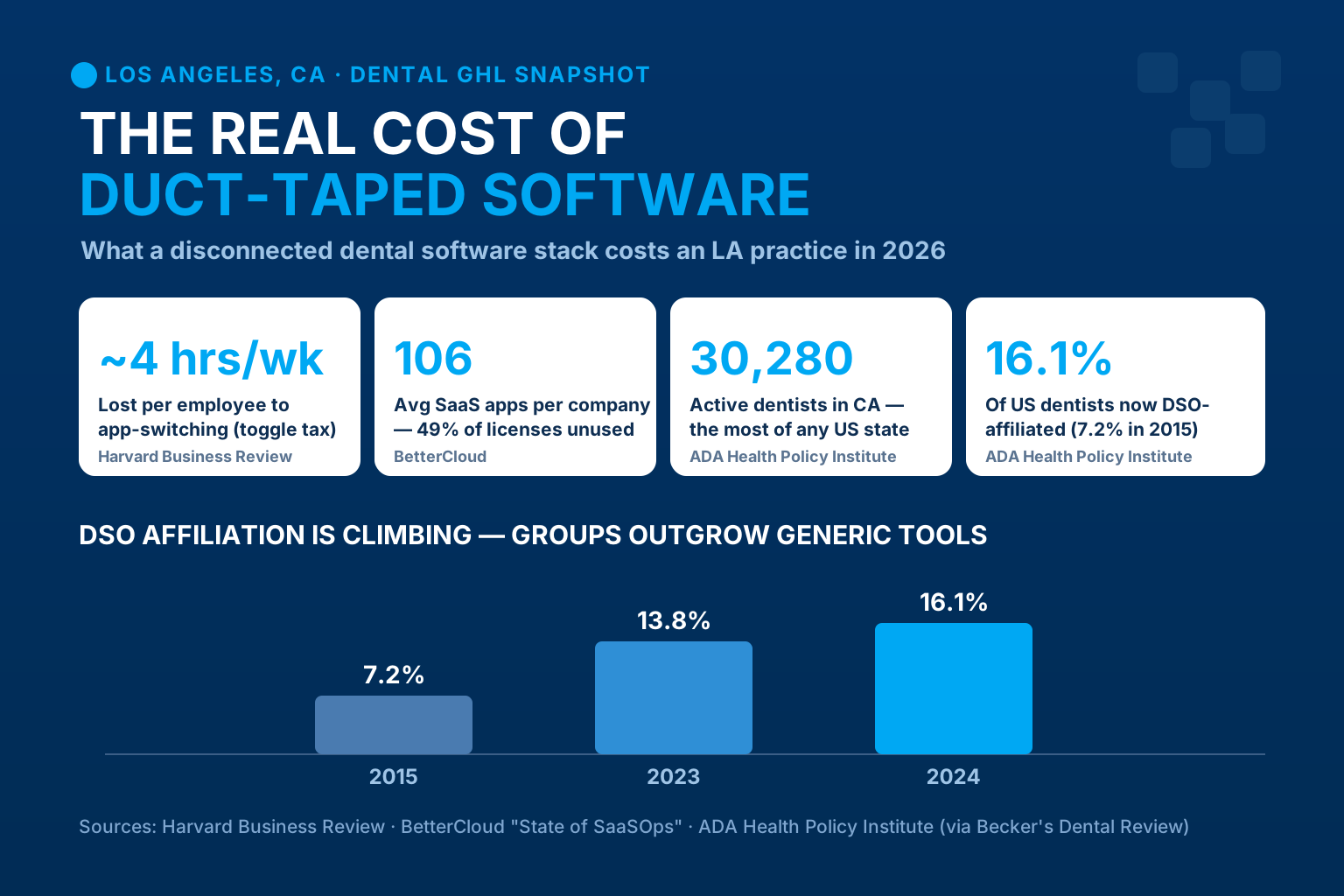
Table of contents
- The short version: what a software “junk drawer” costs
- Why LA dental practices end up duct-taping tools
- The five hidden costs of disconnected dental software
- Off-the-shelf vs. custom-built: when does custom pay off?
- What custom dental software actually looks like
- How to know it’s time (a 6-point checklist)
- FAQ
The short version: what a software “junk drawer” costs
Walk into the back office of most growing LA practices and you’ll find the same thing: a practice management system (Dentrix, Open Dental, or Eaglesoft) for clinical and billing, a separate scheduling widget on the website, a generic CRM or email tool for marketing, a spreadsheet for the recall list, another for insurance follow-up, a texting app the front desk pays for out of pocket, and a reviews tool nobody remembers signing up for.
None of them talk to each other. So your team becomes the integration. A new patient calls; someone types them into the PMS, then again into the CRM, then adds them to the recall spreadsheet. A patient no-shows; someone has to notice, then manually text, then flag it somewhere. Every handoff is a chance to drop a lead, double-book a column, or let a $4,000 treatment plan go cold because the follow-up lived in a tab nobody opened.
That manual glue has a measurable price. Harvard Business Review’s study of nearly 140,000 hours of employee activity found the average worker toggles between apps and windows almost 1,200 times per day, and that reorienting after each switch adds up to just under four hours a week — about 9% of their time at work (HBR). Asana’s survey of more than 9,600 knowledge workers found the same drain from a different angle: workers lose 209 hours a year to duplicated work and spend 60% of their time on “work about work” rather than the job itself (Asana Anatomy of Work 2023). For a five-person front office, that’s the equivalent of losing most of a full-time employee to nothing but clicking between systems.
Why LA dental practices end up duct-taping tools
No one chooses a junk drawer. It accumulates. You start with a PMS. Then you add a website with a booking widget. Then a marketing tool because the PMS can’t nurture leads. Then a texting app because patients don’t answer the phone. Each tool solves one problem and creates a new seam. Two years later you’re running a dozen subscriptions and none of them share a patient record.
Two forces make this worse specifically in Los Angeles:
1. The market is enormous and crowded. California has 30,280 active dentists — more than any other state, well ahead of Texas (16,522) and New York (14,146) (Becker’s Dental Review, ADA HPI data). In a metro that dense, the practice that responds to a new-patient inquiry first and runs recall without gaps is the one that fills chairs. Fragmented software is exactly what slows that response down.
2. Practices are consolidating — and groups outgrow off-the-shelf fastest. DSO affiliation among U.S. dentists has more than doubled, from 7.2% in 2015 to 16.1% in 2024, and it’s highest among younger dentists — 27% of those within a decade of dental school are DSO-affiliated (ADA HPI, via Becker’s). The moment a practice becomes two locations, the spreadsheets break: you can’t see production by provider across sites, recall compliance by location, or which marketing source actually books.
Share of U.S. dentists affiliated with a Dental Service Organization (DSO), by year. Consolidation more than doubled in under a decade — and multi-location groups are the practices that outgrow generic software first. Source: ADA Health Policy Institute, via Becker’s Dental Review.
The irony is that adding more off-the-shelf tools to fix the gaps usually deepens the problem. That’s how you end up in the SaaS-sprawl statistics: the average company now runs 106 SaaS applications, with 49% of the licenses never used (BetterCloud, 2024 State of SaaSOps). Every tool is another login, another data island, another thing to reconcile by hand.
Average number of SaaS applications per company. Even after companies started deliberately cutting tools, the typical business still juggles ~106 disconnected apps. Source: BetterCloud, 2024 State of SaaSOps.
The five hidden costs of disconnected dental software
When people picture the cost of software, they picture the subscription. The expensive part is everything the subscription doesn’t do. Here are the five costs that quietly compound in a fragmented dental stack.
1. Re-keying the same data into five systems
Every patient who touches your practice gets entered by hand into the PMS, the CRM, the recall list, and often the texting tool. It’s slow, it’s error-prone, and it’s exactly the app-toggling that costs the average worker ~4 hours a week (HBR). Worse, the copies drift out of sync — the phone number is updated in the PMS but not the CRM, so the reminder texts the wrong number and the patient no-shows.
2. Paying for shelfware
With 49% of SaaS licenses going unused on average (BetterCloud), most practices are paying for seats, tiers, and tools they abandoned. The reviews platform someone trialed, the second texting app, the marketing suite you use 10% of — it adds up to real monthly spend for near-zero return, on top of the labor to maintain it.
3. Data silos that drop revenue on the floor
This is the one that actually costs production. Recall, reactivation, and insurance follow-up only work if the system knows which patients are due, lapsed, or waiting. When that information is scattered across a PMS report, a spreadsheet, and someone’s memory, patients slip through — and in dentistry, a slipped recall or an un-followed-up treatment plan is direct lost revenue. This is the exact gap our insurance verification automation and recall reactivation posts dig into: the money is already in your patient base; disconnected tools just make it invisible.
4. No single source of truth — so reporting is guesswork
Ask a growing group “what’s your recall compliance rate by location this quarter, and which marketing source produced the most booked treatment?” and watch the scramble. When data lives in five systems, every report is a manual export-and-merge that’s out of date the moment it’s finished. You can’t optimize what you can’t see, and duct-taped software makes clean visibility nearly impossible.
5. Patients feel the friction
Fragmentation isn’t just a back-office tax. It’s the patient who fills out the same intake form three times, the estimate that takes two days because someone had to pull it from another system, the confirmation text that never arrives because the tools didn’t sync. In a market where an LA patient can book the practice down the street in two taps, a clunky experience is a competitive liability.
Off-the-shelf vs. custom-built: when does custom pay off?
Custom software is not the answer for everyone. A single-location practice that’s happy with its PMS and just needs marketing automation should start with a proven, pre-built system — which is exactly why we built the Dental GHL Snapshot and offer GoHighLevel setup for dentists. Off-the-shelf is faster and cheaper until you hit its walls.
The threshold is different for every practice, but the pattern is consistent. Here’s the honest comparison:
Off-the-shelf tools vs. custom-built dental software
| Plan | Off-the-shelf stack | Custom-built systemRecommended |
|---|---|---|
| Price | Low upfront | Higher upfront |
| Feature 1 | Fast to launch — sign up and go | Weeks to build — but built around how you actually run |
| Feature 2 | You bend your workflow to fit the tool | The software fits your columns, recall intervals, and fields |
| Feature 3 | Data lives in separate silos you reconcile by hand | One source of truth — no re-keying, no drift |
| Feature 4 | Reporting is manual export-and-merge | Live dashboards: production by provider, recall by location |
| Feature 5 | Add a tool for every new need (sprawl) | One system that grows with you instead of more logins |
| Feature 6 | You never own it — pricing and features can change | You own the IP — deployable to your own infrastructure |
| See what we build → |
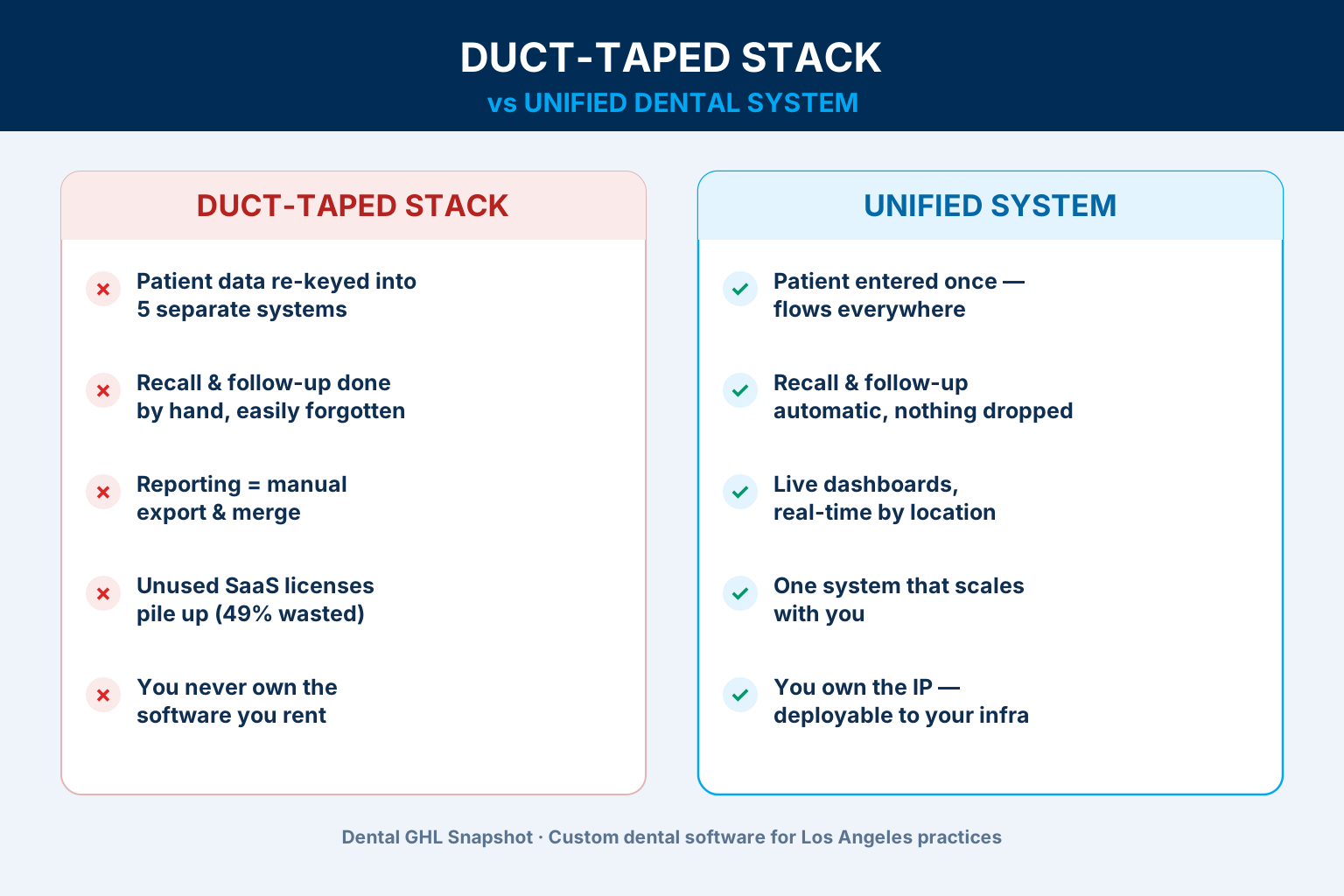
The math tips toward custom when the cost of the duct tape — the re-keying hours, the unused licenses, the dropped follow-ups, the reporting blindness — is bigger than the cost of a build. For a busy single location, that day may never come. For a two-, three-, or five-location LA group, it usually arrives faster than owners expect, because every new location multiplies the manual reconciliation.
What custom dental software actually looks like
“Custom software” sounds like a moonshot. In practice, for a dental practice or group, it’s usually one of a few concrete builds — and modern AI-assisted development (we build with Claude Code) makes them faster and far cheaper than the traditional dev-shop quotes owners remember.
- A dental-specific CRM. Not a generic sales CRM bent to fit — a patient-relationship system that speaks treatment-plan pipelines, recall intervals, hygiene reactivation, referral tracking, and insurance fields, built around how your practice runs. (See our breakdown of what a real dental CRM does.)
- A patient / application portal. A secure place for patients to complete intake once, e-sign consents, upload insurance and records, view treatment estimates, and message the front desk — so the same form never gets filled out three times.
- A unified data layer. The integration work that makes your PMS, GHL, and website share one patient record. We connect Dentrix, Open Dental, Eaglesoft, or Curve to GoHighLevel with two-way sync via APIs, webhooks, or scheduled jobs — and automate the systems that have no API at all.
- Custom AI agents. Voice and chat agents trained on your services, insurances, and booking rules — an AI receptionist that answers 24/7, an intake agent, a follow-up agent — plugged straight into your stack instead of bolted on as yet another silo.
- Production dashboards. Real-time views a growing group actually needs: production by provider, conversion by source, recall compliance by location — pulled from every system into one screen.
The point isn’t to rip out your PMS. It’s to stop your team from being the integration between all these tools — to replace manual glue with software that owns the handoffs.
How to know it’s time (a 6-point checklist)
You don’t need custom software because it’s trendy. You need it when the friction is costing more than the fix. If you check three or more of these, it’s worth a conversation:
- Your team re-keys the same patient into multiple systems every day.
- You have two or more locations and can’t see production or recall in one place.
- You’re paying for tools you barely use — the SaaS-sprawl and unused-license problem, in your own back office.
- Revenue leaks from the gaps — recall, reactivation, and treatment follow-up depend on someone remembering.
- Reporting is a manual export-and-merge that’s stale before it’s finished.
- Off-the-shelf tools can’t do the one thing you need — a workflow, a portal, an integration, or a report no product offers.
If most of that sounds like your practice, the duct tape has become the expensive option. The next step isn’t buying another app — it’s scoping what a unified system would replace.
Frequently asked questions
What counts as 'custom dental software'?
Software built specifically for how your practice runs — most commonly a dental-specific CRM, a patient/application portal, a unified data layer that connects your PMS to GoHighLevel and your website, custom AI voice/chat agents, or production dashboards. It's the opposite of a generic tool you bend your workflow to fit. See our custom software page for the full range.
Do we have to replace our practice management system?
No. The goal is almost never to rip out Dentrix, Open Dental, Eaglesoft, or Curve — it's to stop your team from being the manual integration between your PMS and everything else. We connect your existing PMS to GoHighLevel and your other tools with two-way sync so one patient record flows everywhere. Details on our GHL development page.
Isn't custom software slow and expensive to build?
It used to be. We build with Claude Code and modern agentic AI SDKs, which lets a small team ship production dental software far faster than a traditional human-only dev shop — typically in weeks, not months, at a lower cost, with full IP transfer so you own what we build. Book a discovery call for a scoped quote.
How does this help a multi-location LA dental group specifically?
Multi-location groups feel fragmentation worst: every new site multiplies the spreadsheets and blind spots. A unified system gives you one source of truth and live dashboards — production by provider, recall compliance by location, marketing source attribution — instead of manual export-and-merge across sites. California has more dentists than any state, so clean operations and fast follow-up are a real competitive edge.
Can custom software be HIPAA-aware?
Yes. For HIPAA-aware builds we use BAA-eligible vendors and configure logging, access controls, and data handling to match your compliance requirements — discussed at the discovery call. We implement engineering controls consistent with HIPAA and recommend your legal counsel review the final architecture. We do not claim HIPAA certification on your behalf.
What if we just need marketing automation, not custom software?
Then start with the pre-built system — that's the cheaper, faster path. The Dental GHL Snapshot gives a single practice appointment reminders, recall, review harvesting, and speed-to-lead without a custom build. Move to custom only when you hit its walls.
About the author
Devin Okafor is a GoHighLevel Automation Specialist based in Austin, Texas. He builds and ships GoHighLevel snapshots and custom software for dental practices and the agencies that serve them, and he’s opinionated about keeping systems simple enough for a busy front desk to actually maintain. He writes about the automations and builds that earn their place — and the ones that don’t.