

It is 4:50 on a Thursday. The server in the back closet just threw an error for the third time this month, the Dentrix renewal quote is sitting in your inbox with a number you were not expecting, and your dentist leans over the front desk and asks the question you have been dreading: “Should we just switch?” You answer it, because you run the software, train the team on it, and fight with it when a claim will not send.
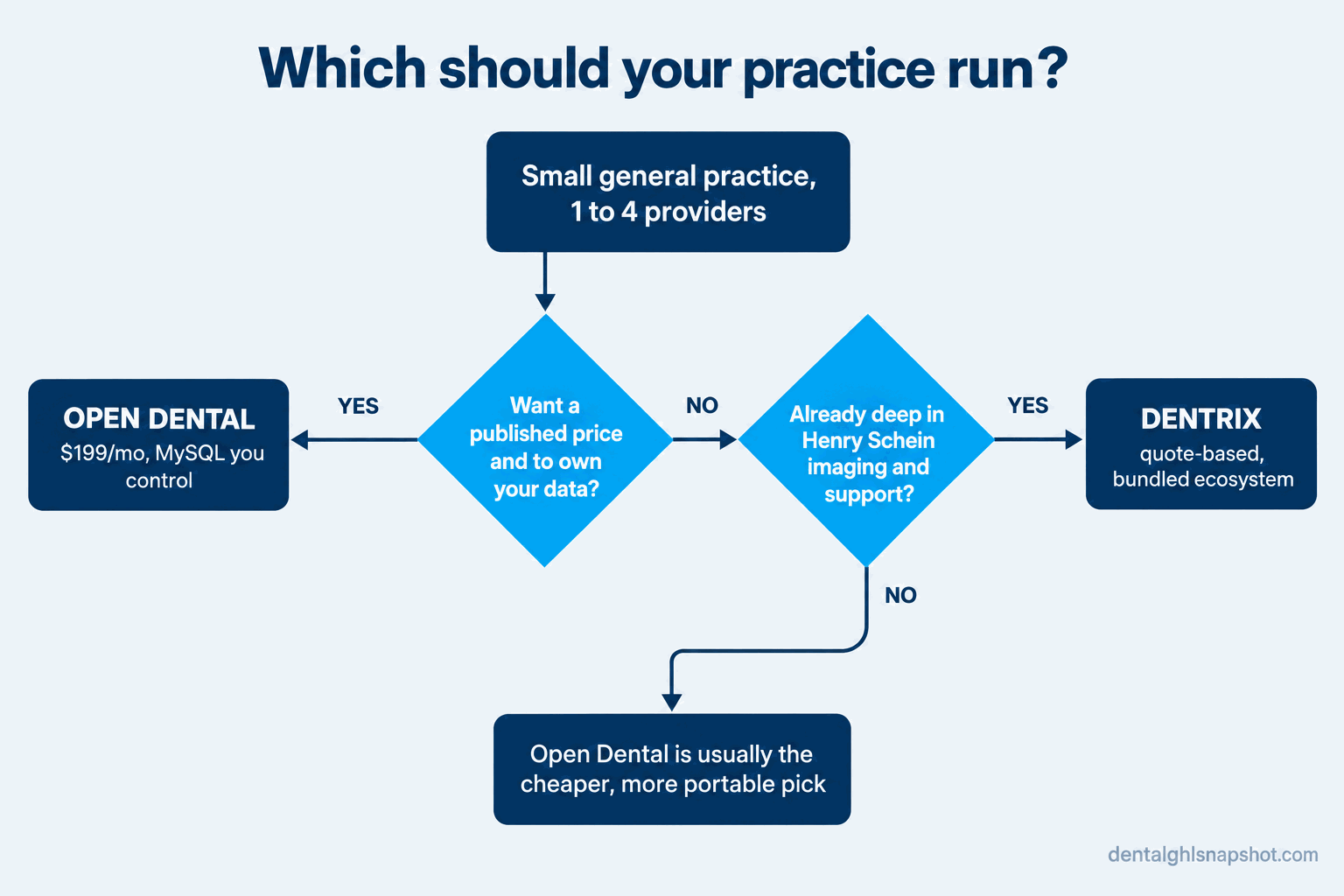
Short answer: For a solo or small general practice, Open Dental is almost always the cheaper, more transparent, more portable choice. It publishes its price ($199 a month per location year one, $149 after 12 months), you hold your own database, and you can leave without begging for a data export (Open Dental fees). Dentrix wins when you are already invested in Henry Schein imaging and support and want one vendor for everything, quote-only price and all. Here is the head-to-head on the eight things that actually decide it.
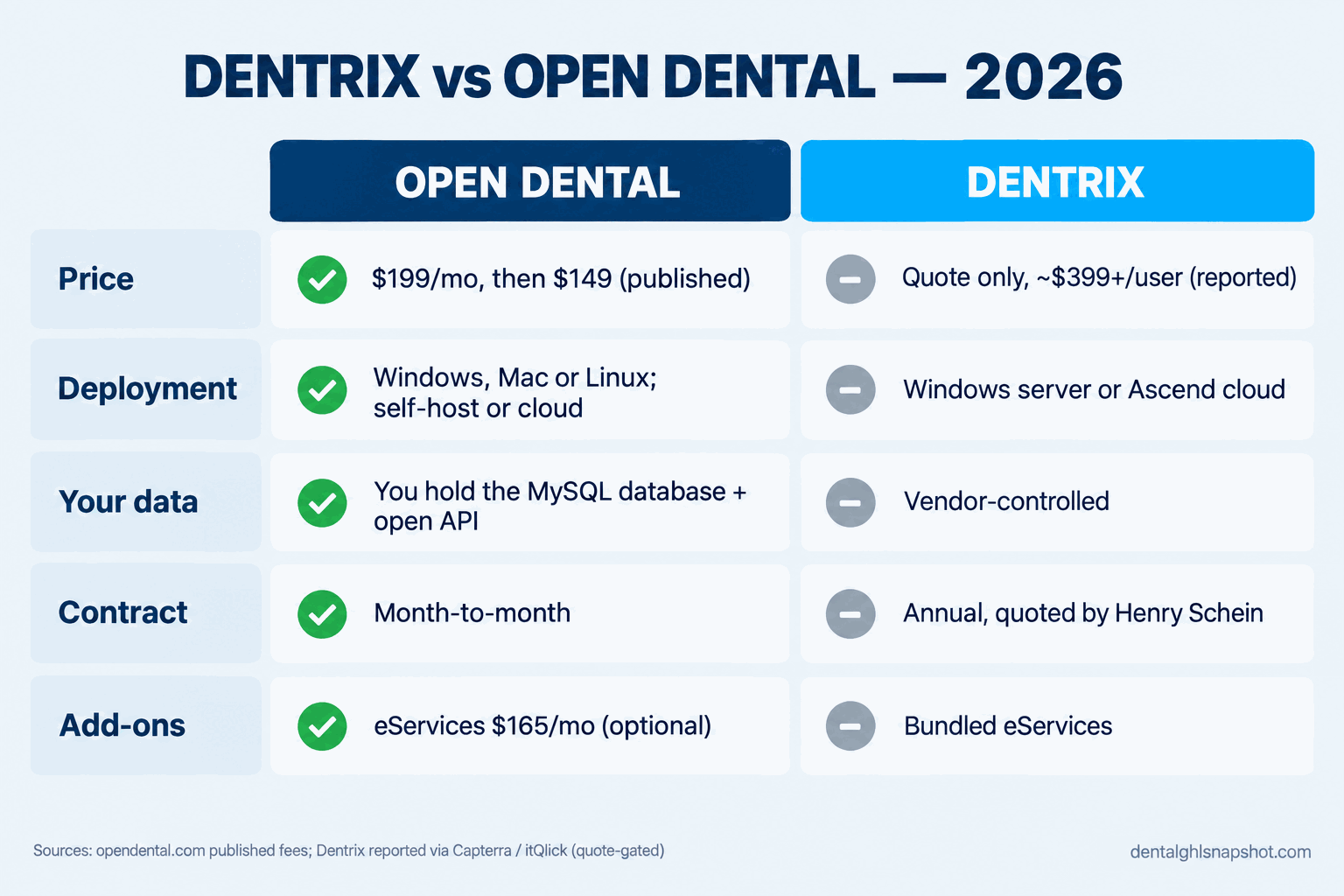
Table of contents
- Two tools, two philosophies
- The eight things that actually differ
- Dentrix vs Open Dental at a glance
- What it actually costs: three scenarios
- The compliance line nobody quotes you
- Steal this: the demo-call script and switch checklist
- Objections, answered honestly
- FAQ
Two tools, two philosophies
Dentrix and Open Dental do the same job. Both chart, bill, schedule, and send claims. But they come at it from opposite directions, and that is what you are really choosing between.
Dentrix is the incumbent, owned by Henry Schein One, closed source, and sold the old way: book a demo, get a quote, sign an annual agreement. You get one vendor for the software, imaging, support, and most add-ons, which appeals to a practice that wants a single throat to choke. Open Dental grew up the opposite way. It runs on a plain MySQL database, works on Windows, Mac, or Linux, and the price is printed on the website. You own your data, can hire any consultant to work on it, and can walk away whenever you want. The right answer depends on which philosophy fits how you run your front office.
The eight things that actually differ
1. Pricing: a published flat fee vs a quote you pry loose
Open Dental charges $199 a month per location for 12 months, then $149. That covers the software, full phone support, every update, and all computers for up to three dentists, with a fourth dentist and beyond at $20 a month each, all of it readable before you talk to anyone (Open Dental fees).
Dentrix will not give a number without a demo. Reported Dentrix Ascend (cloud) figures start near $399 per user per month and scale with seats, with listings citing roughly $799 at ten users (Capterra, itQlick). The on-premise product is a larger up-front license plus a monthly support plan (CostBench).
Monthly cost, per location or the user count shown. Dentrix figures are third-party reported because Dentrix does not publish pricing. Sources: Open Dental, Capterra, itQlick.
How this breaks: The sticker is never the whole bill. Open Dental’s modules add up, and Dentrix quotes leave implementation and conversion off the first pass. Ask for the all-in year-one number in writing, the way we laid it out in what dental software actually costs in 2026.
2. Cloud or server: where the software runs
Open Dental is traditionally self-hosted on a server you control, so it runs offline if your internet drops, but it also offers hosted Open Dental Cloud. Dentrix comes two ways: an on-premise version that needs a Windows server in the office, and Dentrix Ascend, the cloud version with updates and backups handled for you.
How this breaks: The cloud-versus-server choice quietly sets your IT bill. Self-hosted needs someone to own backups and patching, and “someone” is often you by default. Price the IT support, not just the license.
3. Who owns your data, and can you leave?
This matters most and gets discussed least. With Open Dental, your records, ledgers, and schedule live in a MySQL database you hold, with direct read access and an open API. If you want to switch or run your own reports, you can, without permission.
One honest correction: people still call Open Dental “open source,” and as of version 24.4 (March 2025) that is wrong. It moved from GPL to a proprietary license, though Open Dental says price, support, database access, and the API were untouched (license). You still own your data; you just should not call the software open source. Dentrix keeps your data in its own closed system, and a clean export goes through the vendor.
How this breaks: Data ownership feels abstract until the day you want to leave, when a switch can be quoted at thousands of dollars and weeks of delay. Get your right to a full data export in writing before you sign.
4. Imaging, integrations, and the open API
Dentrix integrates tightly with Henry Schein imaging and a large catalog of partner add-ons, because vendors build to the incumbent first. Open Dental supports broad third-party imaging and tools, and its open API lets a developer wire up almost anything, from an AI chatbot to a GoHighLevel communication layer. The tradeoff is you sometimes arrange the connection rather than getting it pre-bundled.
How this breaks: Imaging is the sneaky lock-in. If your sensors and software are tied to one ecosystem, switching cost is not just the PMS, it is re-validating every bridge. Inventory your imaging first.
5. Insurance claims and eligibility
Both send electronic claims and plug into the usual clearinghouses. On Dentrix, eClaims and eligibility sit in the eServices bundle folded into the quote. On Open Dental they are published add-ons, so you turn on what you use. For an office fighting an insurance accounts receivable backlog, the real question is not “does it send claims” but “how many clicks, and how good is the eligibility response.” Test that in a live demo with your actual carriers.
How this breaks: Eligibility data is only as good as the feed behind it. Neither system removes the need for a human to read a benefits breakdown before a big case. Treat it as a first pass, not the final word.
6. The switching cost, in both directions
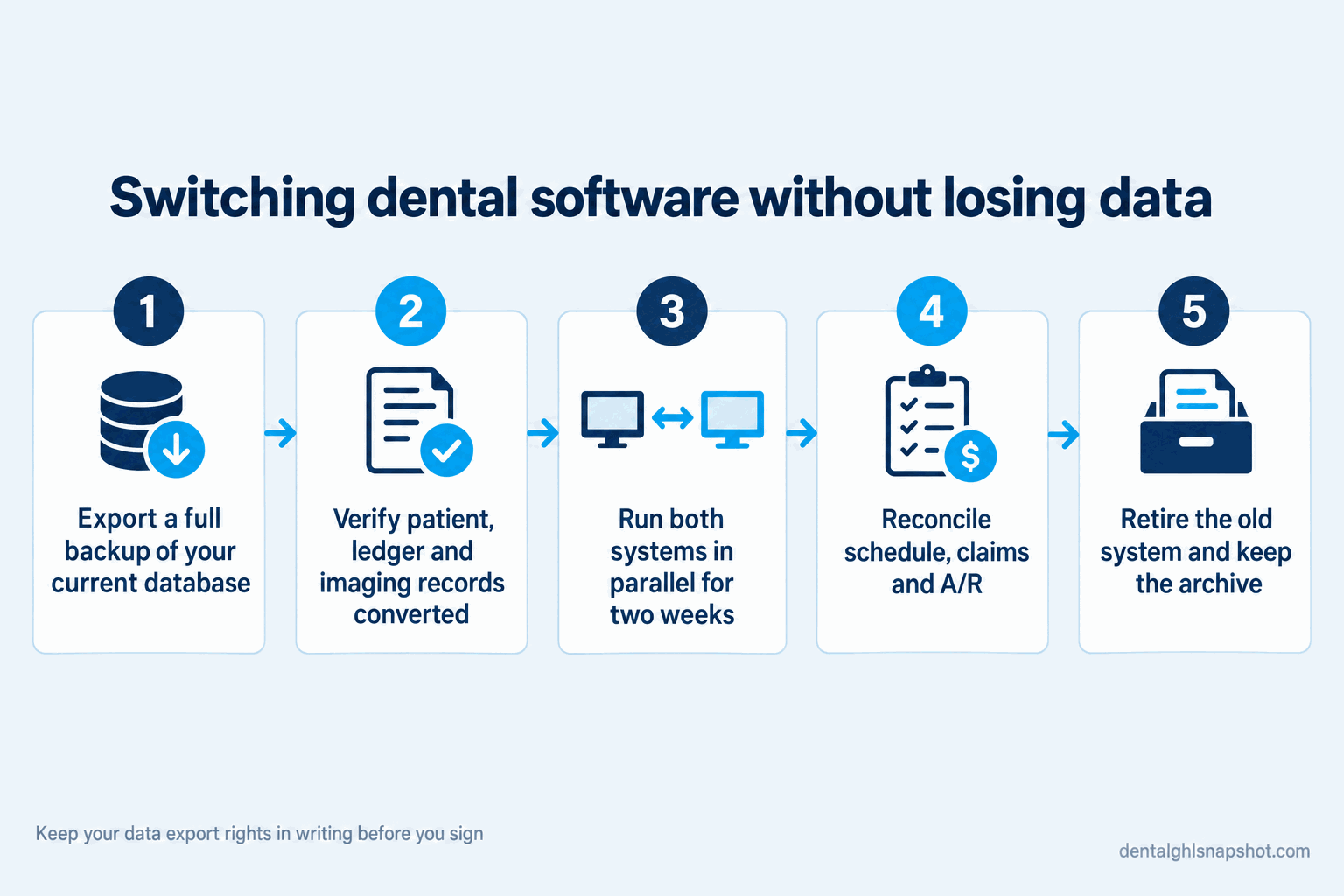
Moving off either system is a project: export the database, convert and verify that patients, ledgers, and imaging came across, run both systems in parallel for a couple of weeks, then reconcile the schedule, claims, and A/R before you retire the old one. Because Open Dental hands you your data, leaving it is easier. Leaving Dentrix usually means a vendor-assisted conversion, which is why established Dentrix offices tend to stay put even when the renewal stings. That inertia is a fair reason to negotiate hard instead of moving.
How this breaks: The top way a migration fails is going live before verifying the conversion. A dropped ledger balance or a mismatched recall date surfaces weeks later as an angry patient or a missed hygiene visit. Never skip the parallel run.
7. Support, training, and the learning curve
Dentrix support comes from Henry Schein One, bundled into the support plan or the Ascend subscription. Because Dentrix has the largest installed base in the country, it is the system most temps and new hires already know, which shortens training and makes hiring easier. Open Dental includes full phone support in its fee, with a deep community and independent consultants, but its interface is a little less polished than the newest cloud products.
How this breaks: Team adoption sinks more switches than the software does. If three of four staff run Dentrix in their sleep, retraining is a line item you have to count. Pair any switch with hands-on training and a named champion, or the new system reverts to sticky notes.
8. Scaling: adding operatories, providers, and locations
Open Dental’s flat per-location fee, with a small per-dentist charge beyond three, makes cost easy to predict. Add a location, add about $149 a month. Add a fourth dentist, add $20. Dentrix pricing scales with users and seats, so the monthly climbs as you add providers, and multi-location setups are quoted individually.
How this breaks: Per-user pricing looks fine at two chairs and ugly at twelve. If you plan to add operatories or a second location, run the three-year cost at your projected size, not today’s. The cheaper entry price is not always cheaper by year three.
Dentrix vs Open Dental at a glance
| Open Dental | Dentrix | |
|---|---|---|
| Published price | Yes, on the website | No, quote only |
| Entry cost | $199/mo, then $149/mo per location | ~$399+/user/mo (Ascend, reported) |
| Per-provider fee | Free up to 3, then $20/mo each | Scales with users and seats |
| Deployment | Self-host or Open Dental Cloud | On-premise server or Ascend cloud |
| Your data | You hold the MySQL database, open API | Vendor-controlled, export via Dentrix |
| Contract | Month-to-month | Annual, quoted by Henry Schein One |
| Best for | Cost-conscious independent practices | Offices wanting one bundled vendor |
Sources: Open Dental fees and license, Dentrix, Capterra.
What it actually costs: three scenarios
Ranges are useless when you are building a budget. Here is the year-one math for three sizes. Your Dentrix quote will vary, but the shape holds.
Estimated year-one software cost by practice size
| Plan | Solo (1 dentist, 2 ops) | Mid (3-4 providers, 5 ops)Recommended | Multi-location (3 sites) |
|---|---|---|---|
| Price | ≈ $2,400 vs $5,000+ | ≈ $2,600 vs $10,000+ | ≈ $5,400 vs quoted |
| Feature 1 | Open Dental: ~$2,388 year one, ~$1,788 after | Open Dental: ~$2,388 + ~$240/yr for a 4th dentist | Open Dental: ~$149/mo x 3 = ~$5,364/yr after yr 1 |
| Feature 2 | Dentrix Ascend: ~$4,788 + ~$1,000 to $3,000 setup | Dentrix Ascend: scales with seats, plus setup | Dentrix: enterprise, quoted per site and per user |
| Feature 3 | Open Dental covers all 3 dentist slots free | Per-seat pricing is the swing factor here | Predictable flat fee vs a custom contract |
Even the transparent option is not one line item. Open Dental’s published monthly add-ons stack on the base fee, per location: an eServices bundle at $165, online scheduling at $75, patient check-in via eClipboard at $45, secure email at $30, and AI image analysis at $149. You pay only for what you switch on (Open Dental ordering).
The compliance line nobody quotes you
HIPAA is the hard line, and it does not care which PMS you chose. The practice owns protected health information, so three rules hold on either platform.
First, any vendor that touches patient data needs a signed Business Associate Agreement: your PMS, your imaging host, and any communication tool you add.
Second, where your data lives changes your risk surface. A self-hosted server puts backup and breach responsibility on you. A cloud product shifts some of that to the vendor under the BAA, but you still own patient consent and access controls.
Third, and this is where offices actually slip: a text or email reminder may carry the appointment date, time, provider name, and a reschedule link, and nothing more. No procedure names, no balances, no treatment details, because a lock screen is a public screen. That rule is identical on Dentrix, Open Dental, or a separate system, and it is the most common violation we see. The full playbook is in the dental patient texting compliance guide.
How this breaks: Practices assume the software is “HIPAA compliant” and stop thinking. Compliance is shared. The vendor provides the safeguards; you still sign the BAA, configure them, train the team, and keep PHI out of plain messages.
Steal this: the demo-call script and switch checklist
Because Dentrix will not publish a price, you extract one. Use this on the sales call, word for word.
“Before we go further, I need four numbers in writing to compare fairly against Open Dental’s published $199 a month. One: the all-in monthly cost for [X providers] and [Y operatories], cloud and on-premise separately. Two: the one-time implementation, training, and data-conversion fee. Three: the contract length and the early-termination penalty. Four: what it costs to get a complete export of my data if I ever leave. Can you email those four, itemized, today?”
If the rep will not put those in writing, that is your answer about how the relationship will go. When you do switch, run it as a project.
- Export and back up a full copy of your current database before anyone touches anything.
- Convert and verify that patients, ledgers, A/R, imaging, and recall dates came across, on a record-by-record sample.
- Run both systems in parallel for at least two weeks so a conversion gap surfaces while the old system is live.
- Reconcile the schedule, open claims, and outstanding A/R before you cut over.
- Train the team with hands-on sessions and name one internal champion.
- Retire the old system only after a clean reconciliation, and keep the archive somewhere you can reach it.
Objections, answered honestly
“I already pay for Dentrix. Isn’t switching just a hassle for a lower bill?” Often, yes, and that is a fair call. If your team knows Dentrix cold, your imaging is tied to it, and the renewal is reasonable, switching cost can outweigh the savings. Use the numbers above to negotiate the renewal first, and only price a move if the quote still stings.
“Open Dental is open source, so is it risky or unsupported?” This is the most common misconception, and it is now doubly wrong. Open Dental is no longer open source as of version 24.4; it is proprietary software with published pricing and full phone support in the fee, used by thousands of practices (Open Dental license).
“Do I need an IT person to run Open Dental?” For a self-hosted setup, you need someone who owns backups and updates, which can be a part-time IT vendor. If you would rather avoid hardware, Open Dental Cloud removes most of that, the way Dentrix Ascend does.
“Will I lose patient data if I switch?” Not if you run the migration correctly. The risk is not the move, it is going live before verifying the conversion. Follow the parallel run, reconcile before cutover, and keep the archive. Losing data comes from rushing, not from switching.
Frequently asked questions
Is Open Dental cheaper than Dentrix?
For almost every small and midsize practice, yes. Open Dental publishes $199 a month per location year one and $149 after, covering up to three dentists, with $20 per additional dentist. Dentrix is quote-only and reported well above that, scaling with user count.
Is Open Dental still open source in 2026?
No. It moved from a GPL open-source license to a proprietary one in version 24.4 (March 2025). Open Dental says price, support, database access, and the API were unchanged, so you still own and can access your data. The software is simply no longer open source.
Can I move my data from Dentrix to Open Dental?
Yes, through a data conversion that migrates patients, ledgers, imaging, and schedule. It is a project, not a one-click export. Run both systems in parallel and reconcile before retiring Dentrix, and get your export rights in writing before you sign.
Does Dentrix or Open Dental run in the cloud?
Both offer a cloud option. Dentrix Ascend is the cloud product, and Dentrix also sells an on-premise server version. Open Dental is traditionally self-hosted but also offers Open Dental Cloud. Self-hosted keeps running during an outage; cloud removes most of the IT upkeep.
Which is easier for my front desk to learn?
Dentrix has the largest installed base, so more temps and new hires already know it, which shortens training. Open Dental is powerful but a little less polished, so budget hands-on training either way and name an internal champion.
Do these handle patient texting and recall marketing?
Only at a basic reminder level. Both are systems of record for charting, billing, and scheduling, not a full communication layer. Two-way texting, missed-call recovery, review requests, and lifecycle recall usually come from a separate tool that connects to your PMS.
The bottom line
Back to that 4:50 Thursday and your dentist waiting. The honest answer: if you want the price up front, your data in your hands, and a predictable monthly, Open Dental is the stronger pick, and the margin is not close on cost. If you are deep in the Henry Schein ecosystem, value one bundled vendor, and your team knows Dentrix cold, staying put and negotiating the renewal is a rational call.
Whichever you run, remember the part neither one does: your PMS will not answer the phone at 7:40am, text the patient who no-showed, or ask the happy patient for a review. That is the layer that fills the schedule, and it is a separate decision. If you want it handled for you, see what the done-for-you snapshot includes.
Keep reading: what dental software actually costs in 2026, the best Weave alternatives, and two-way texting patients actually reply to.