

Short answer: Only one major dental software company will tell you its real price without a demo. Open Dental publishes it: $199 per month per location the first year, dropping to $149 after 12 months, with no per-provider penalty until your fourth dentist (Open Dental fees page). Everyone else, Dentrix, Eaglesoft, Weave, Solutionreach, hides the number behind a “schedule a demo” button, and the real cost lands between $300 and $1,600 a month once you add the pieces they leave off the first quote. This teardown puts the real 2026 numbers side by side and runs the math for a solo, mid-size, and multi-location practice.
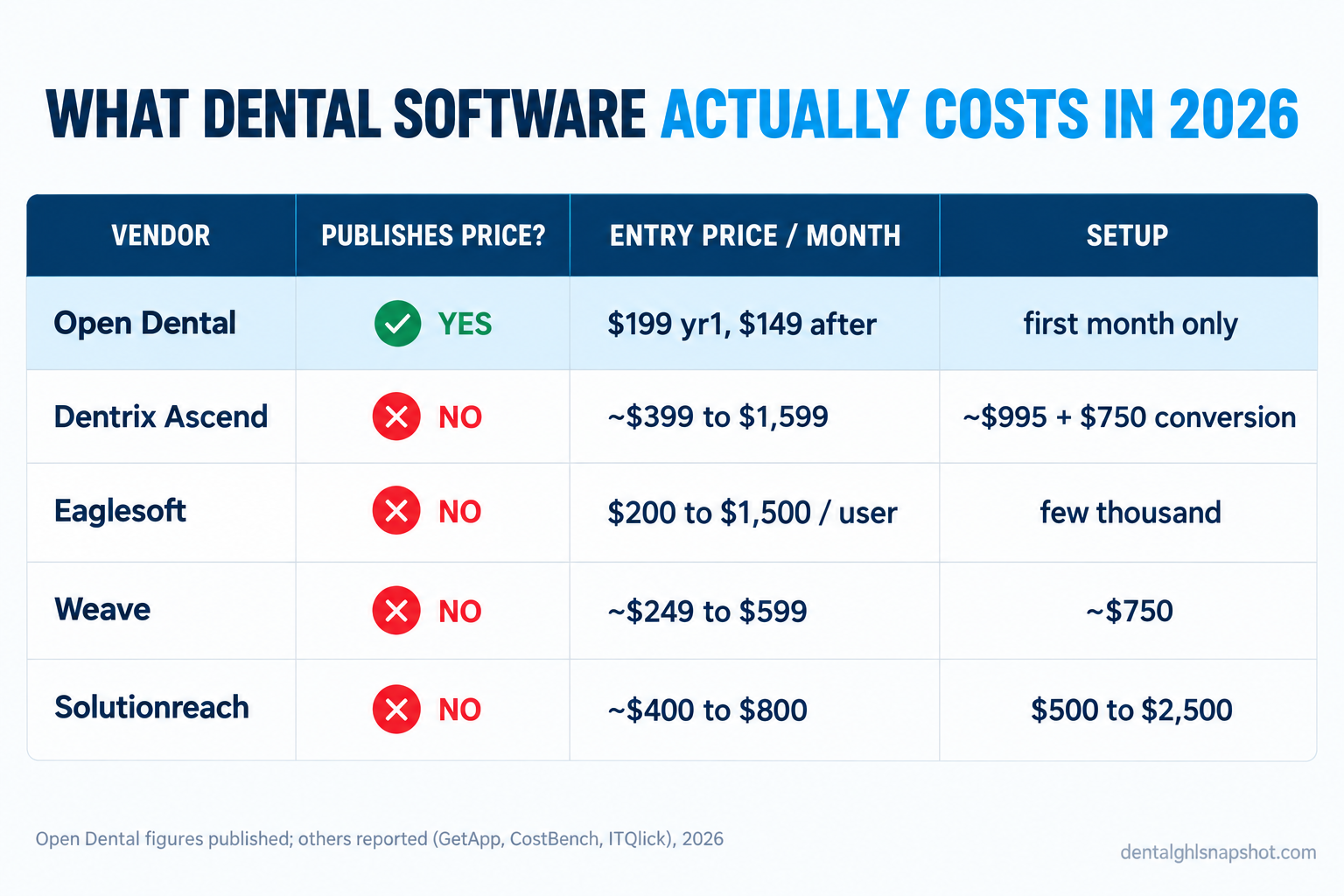
Table of contents
- Why you can’t get a straight price on dental software
- The two bills every practice actually pays
- Practice-management systems: Open Dental, Dentrix, Eaglesoft
- Patient-communication tools: Weave and Solutionreach
- The hidden costs no rep puts on the first quote
- What it actually costs: three real scenarios
- The compliance line item nobody prices
- Steal this: the demo-call script that gets a real number
- Objections and honest answers
- FAQ
Why you can’t get a straight price on dental software
It is 8:15 on a Tuesday. You have two holes in the hygiene column, a verification you never finished, and a sticky note that says “call about the software renewal.” You ask what it costs. The rep says, “It depends. Let’s get you on a quick demo.” Forty minutes later you have a slide deck, a “special” price that expires Friday, and no number you can put in a budget.
That is not an accident. If nobody can line up five quotes side by side, nobody can tell you are overpaying, so the price hides behind a demo and the contract is annual before you have seen a second bill. But the numbers are knowable. Open Dental publishes its fees, so those are exact; the figures for Dentrix, Eaglesoft, Weave, and Solutionreach are what practices report paying (via GetApp, SelectHub, CostBench, ITQlick) and are labeled as reported below.
The two bills every practice actually pays
Practices pay for two different kinds of software, and confusing them is where the money leaks.
Bill one is your practice-management system (PMS): the schedule, chart, ledger, imaging, claims, and reporting. Dentrix, Eaglesoft, and Open Dental live here. Switching it is a real project, which is why the vendors can charge what they charge.
Bill two is your patient-communication layer: texting, reminders, review requests, online scheduling, sometimes the phones. Weave and Solutionreach live here. It sits on top of your PMS, and it is the part most practices overpay for, because they buy it piecemeal and never add up the total.
The costliest mistake is treating these as one line item. A practice will say “we pay about $500 a month for software,” mean the PMS, and forget the $400 they also pay for Weave, the card-processing markup, and the eServices bundle. Add it up and the communication layer often costs as much as the core system.
Practice-management systems: Open Dental, Dentrix, Eaglesoft
Open Dental: the only one that publishes a price
Open Dental anchors this market because it does the thing no competitor will: it prints the price on its website. The support subscription is $199 per month per location your first 12 months, then $149 per month per location after a year (Open Dental fees page). That covers up to three dentists per location; a fourth or fifth adds about $20 per dentist per month (reported detail). No big upfront license fee, support included, free trial with no expiry.
The catch is the model, not the price: Open Dental expects you to own more of the setup, so practices that want heavy hand-holding sometimes find it lean. Its eServices bundle (texting, scheduling, forms) runs about $165/mo per location (reported), folding the “second bill” into the first.
Dentrix Ascend: the market default, priced by the seat
Dentrix, from Henry Schein One, is the name most practices already know. The cloud version, Dentrix Ascend, is a subscription, and reported pricing scales with users: roughly $399/mo for a single user, ~$799/mo for 10, and ~$1,599/mo at 100 (GetApp). Add a one-time ~$995 enrollment and ~$750 database conversion, with implementation for a smaller practice around $2,000–$5,000 (reported).
Per-user pricing is a growth tax: the quote that looks fine at one dentist and two staff gets more expensive every time you add a chair. Legacy server-based Dentrix also carries an ongoing Customer Service Plan for support and updates, a recurring cost that rarely shows up on the first quote.
Eaglesoft: quote-gated and mid-migration
Eaglesoft, from Patterson Dental, does not publish pricing. Reported figures span a wide $200 to $1,500 per user per month, a single user near the bottom and a ten-user office near the top (CostBench, SelectHub). A typical single-office estimate is around $400–$800 per month (ITQlick).
One moving part matters in 2026: Patterson is pushing Eaglesoft toward a subscription-only model, so practices on older perpetual licenses face migration at renewal (CostBench). A forced model change is a free chance to shop, so get a written number and compare.
Reported entry-level monthly cost for a small single-location practice, in US dollars. Open Dental is vendor-published; Dentrix and Eaglesoft are reported ranges, low end shown. Sources: Open Dental, GetApp, ITQlick.
Patient-communication tools: Weave and Solutionreach
The second bill. These handle the texting, reminders, reviews, and scheduling that fill chairs. They are genuinely useful. They are also where the “wait, we pay how much for that?” moment usually happens.
Weave: the all-in-one that locks you in
Weave bundles VoIP phones, two-way texting, reminders, reviews, payments, and scheduling into one interface. Reported pricing starts around $249/mo per location and climbs to roughly $399–$599/mo for the tiers most practices actually want (The Molar Report, SelectHub). Add a one-time $500–$750 setup plus about $200 to migrate digital forms, and year one for a single location lands near $4,000.
The failure mode to flag: Weave markets flexibility, but practices repeatedly report annual or multi-year contracts with early-termination penalties, not the month-to-month feel the demo gives (Emitrr). Get the cancellation terms in writing before you sign.
Solutionreach: mid-market and demo-gated
Solutionreach targets established and multi-provider practices, and is fully demo-gated. Reported pricing runs about $400–$800 per month for a mid-size practice, with tiered estimates near $299/mo for one user, $599 for ten, and $999 at a hundred (NoShowCost, ITQlick). Expect an annual contract and upfront implementation of roughly $500–$2,500. Treat it like the PMS quotes: get the number in writing and compare the all-in annual cost.
The hidden costs no rep puts on the first quote
The monthly subscription is the part everyone shows you. These turn a tidy quote into a surprise on the second invoice.
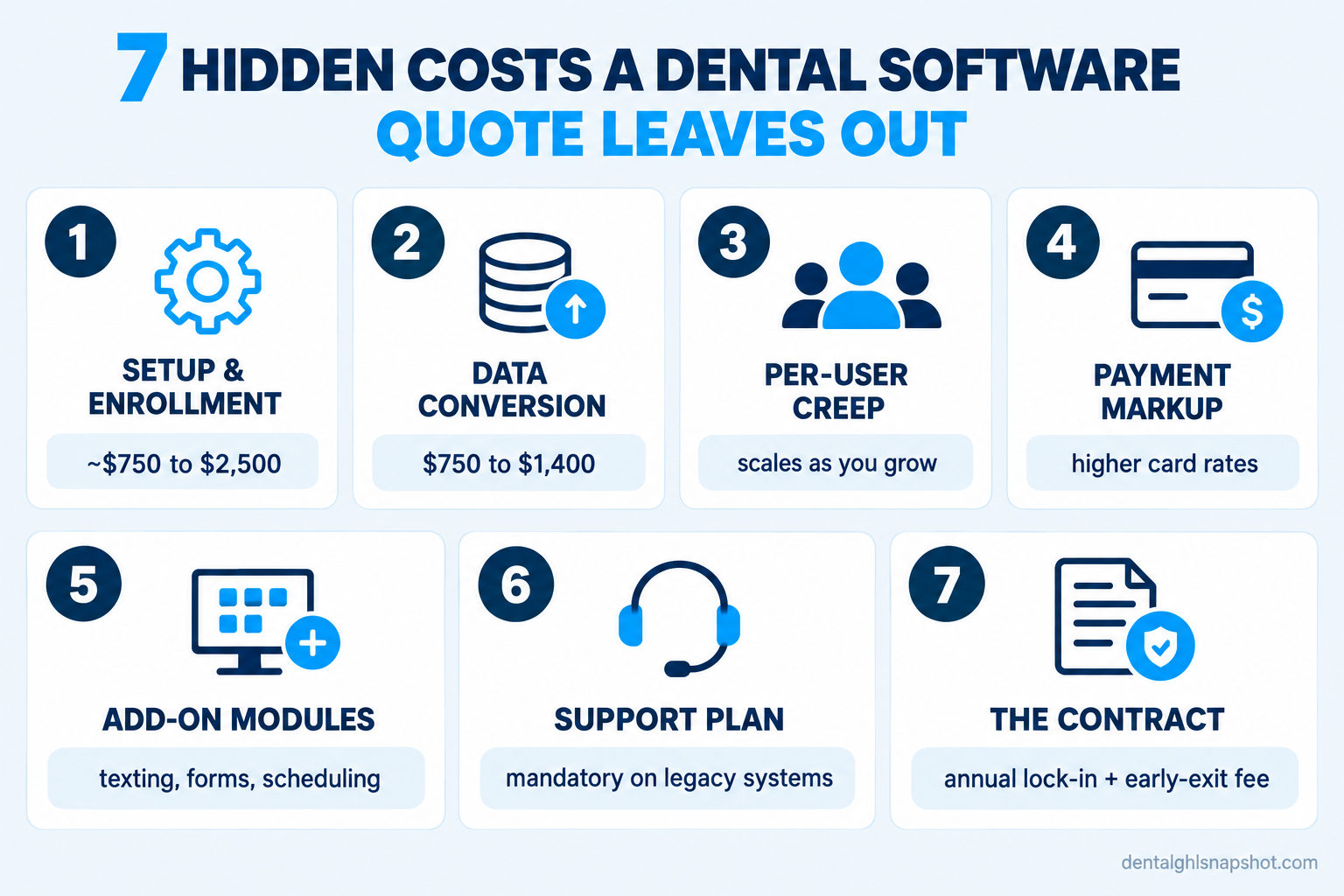
- Setup, onboarding, and enrollment fees. Dentrix’s ~$995 enrollment, Weave’s ~$750 setup, Solutionreach’s up-to-$2,500 implementation. One-time, but they land in the tightest month, the first.
- Data conversion. Moving records off the old system runs a reported $750–$1,400. Unavoidable when you switch, and quotable, so ask before you commit.
- Per-provider and per-user creep. Any per-seat tool gets more expensive exactly as you succeed. Model the cost at the size you expect in two years, not today.
- Payment-processing markup. Many all-in-one tools route card payments through their own processor at a rate quietly higher than a standalone merchant account. On real volume, a fraction of a percent is thousands a year.
- eServices and add-on modules. Texting, scheduling, forms, and secure email are often separate line items. Open Dental bundles them at ~$165/mo; others charge per module.
- The support plan. Legacy Eaglesoft and Dentrix carry mandatory support plans on top of the license. Confirm whether support is included or extra.
- The contract itself. An annual lock-in with an early-termination fee is a cost even when it never appears as a line item, because it is the price of being wrong.
The way to surface all seven at once is one question, in the demo script below: get a single all-in first-year total, in writing, before you sign.
What it actually costs: three real scenarios
You budget in real dollars, not ranges. Here is the year-one math for three practices, built from the numbers above. Your quote will vary, but the shape holds.
Estimated year-one software cost by practice size
| Plan | Solo practice (1 dentist, 2 ops) | Mid-size (3–4 providers, 5 ops)Recommended | Multi-location (3 sites) |
|---|---|---|---|
| Price | ≈ $2,400–$10,300 | ≈ $8,000–$20,000 | ≈ $5,400–$30,000+ |
| Feature 1 | Open Dental PMS: ~$2,388 (yr 1), ~$1,788 after | Open Dental: ~$2,388 + ~$240/yr extra providers | Open Dental: ~$149/mo × 3 = ~$5,364/yr |
| Feature 2 | OR Dentrix Ascend: ~$4,788 + ~$3,000 setup | OR Dentrix Ascend (10 users): ~$9,588 + $5,000 setup | OR Dentrix at scale: ~$19,000/yr + $10k–$20k setup |
| Feature 3 | Plus Weave comms: ~$4,788 + $750 setup | Plus Solutionreach or Weave: ~$6,000/yr | Comms billed per location: ~$14,000+/yr |
| Feature 4 | Heavy route (Dentrix + Weave): ~$10,300 year one | Per-user pricing is the swing factor at this size | Per-location fees multiply fast |
The pattern nobody selling you software will say out loud: the more you grow, the more the per-seat and per-location models punish you, and the more a flat-priced core saves. A mid-size or multi-location group pays for its pricing model every month, which is why the gap between the lean and heavy routes widens into tens of thousands.
Estimated year-one total for a solo practice (2 operatories): PMS plus a patient-communication layer, in US dollars. Built from reported pricing and setup fees; actual quotes vary. Sources: Open Dental, GetApp, The Molar Report.
Put those totals against the average general practice’s $942,290 in annual gross billings (ADA Health Policy Institute, 2024 data) and the point flips: even the heavy route is about one percent of production. You do not win or lose on the software bill; you win or lose on whether the software fills the schedule, and as of Q4 2025 roughly one in three dentists reported they were not busy enough, up from about a quarter a year earlier (ADA HPI). Paying a bit more for a tool that keeps chairs full beats saving a few hundred on one that does not.
The compliance line item nobody prices
There is a cost to getting patient communication wrong, and it never appears on a quote. If a tool sends texts or emails for you, it touches protected health information, which pulls three hard rules into the decision.
A text or email may carry the appointment date, time, provider name, and a reschedule link. That is the whole list. Never a procedure name, balance, diagnosis, or treatment plan, because a message sits on a lock screen where anyone can read it. That exposure is on the practice.
Any vendor that touches that data must sign a Business Associate Agreement (BAA). No BAA, no deal. It is a free document to ask for and a red flag if a vendor hesitates. You also need patient consent to message and a working opt-out (a real STOP handler), and state texting laws in places like Washington, Oklahoma, and Maryland apply wherever your practice sits (HHS on HIPAA).
Do not let any tool “gate” your reviews. Filtering so only happy patients get asked, or routing people by a satisfaction score, violates FTC rules on fake and suppressed reviews (FTC), and plenty of practices are set up this way without realizing it. When you compare communication tools, put “signs a BAA” and “does not gate reviews” on the checklist next to the price. A cheap tool that creates a compliance problem is not cheap.
Steal this: the demo-call script that gets a real number
You will still sit through some demos. Here is the exact set of questions that cuts a 40-minute pitch to the four numbers you need, so you leave every call with an all-in annual figure in writing.
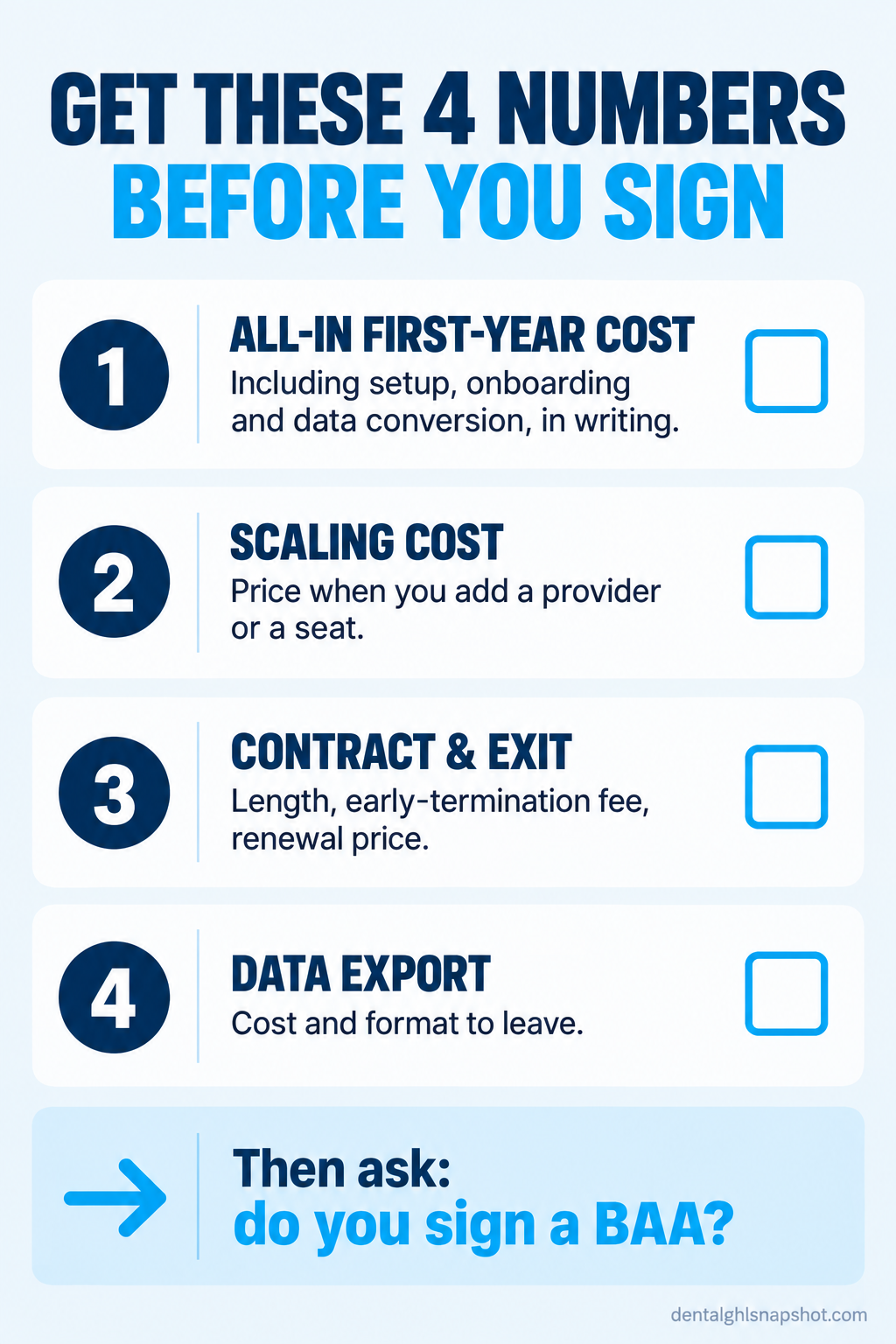
If you are switching systems, the same discipline applies to the move. A clean migration plan and an honest look at what your PMS should and shouldn’t do on its own will save you more than shaving $50 off the monthly, as will the insurance-verification workflow most tools bury in an add-on tier.
Objections and honest answers
“We already pay for Dentrix. Isn’t switching a nightmare?”
Switching your core PMS is a real project, and you should not do it casually. But that is not the only lever. Most practices overpay on the second bill, the communication layer, and you can keep Dentrix or Eaglesoft while still cutting cost by consolidating the reminder, review, and texting tools you bolted on over the years, no data conversion required. When your PMS renewal does come up, use the demo script and make them compete.
“Why does a texting tool cost as much as my whole PMS?”
Because it is sold as a bundle (phones, texts, reviews, payments, scheduling), priced per location, and most buyers never line the two bills up. This is the most common overpayment in a dental stack and the easiest to fix, because the communication layer is less painful to switch than the PMS.
“Do I have to be technical to decide well?”
No, just organized. Get an all-in annual figure from each vendor, in writing, and compare total cost of ownership, not the monthly headline. That is a front-office skill, the same one you use on every other vendor in the building.
The bottom line
You cannot get a straight price from most dental software companies, so stop trying and start demanding one. Anchor every quote against Open Dental’s published $149 to $199 a month, keep your PMS bill and your communication bill separate because the second is where you overpay, and add up the hidden fees before you sign. Against nearly a million dollars in annual production, the software line is about one percent, so the real question is not which tool is cheapest, but which one keeps your chairs full without charging you three times to do it.
If you want the reminder, review, missed-call, and recall pieces handled as one flat-priced system that sits on top of whatever PMS you keep, that is what our done-for-you setup is built to do.
Frequently asked questions
What is the cheapest dental practice management software in 2026?
Among the major systems, Open Dental publishes the lowest transparent price: $199 per month per location the first year, then $149 after 12 months, covering up to three dentists per location (Open Dental fees page). Dentrix and Eaglesoft do not publish pricing and generally run higher once setup and per-user fees are included.
How much does Dentrix cost per month?
Dentrix Ascend is quote-based, but practices report roughly $399 per month for a single user, about $799 for ten users, and around $1,599 at a hundred, plus a one-time enrollment near $995 and a data conversion around $750 (GetApp and reported sources). Your quote depends on user count, modules, and contract terms.
Why won't dental software companies show their prices?
Opaque pricing makes quotes hard to compare, which lets each vendor charge what a practice will pay rather than a public rate, and it funnels you into a demo where a salesperson can anchor you higher. Open Dental is the exception that publishes its fees outright.
Is Weave worth the cost on top of my practice management software?
Weave bundles phones, texting, reminders, reviews, and payments from around $249 per month per location, climbing to roughly $399 to $599 for most practices, plus a setup fee near $750. It can be worth it if it replaces several separate tools, but watch the annual contract and early-termination terms practices report, and confirm the payment-processing rate before you sign.
What hidden fees should I ask about before signing a dental software contract?
Ask about setup and enrollment fees, data conversion, per-provider scaling, payment-processing markups, add-on modules like texting and online scheduling, mandatory support plans, and the contract length with its early-termination fee. Request one all-in first-year total in writing.