

Short answer: Your front desk is not missing calls because your team is careless. They are missing them because one person cannot answer the phone, seat a patient, check someone out, and sit on hold with insurance all at once. The phone rings during the exact minutes the desk is busiest, so it rolls to voicemail, and a good share of those callers are new patients who just dial the next practice on the list. The fix is not “answer faster.” It is to find the six places calls leak and plug each one, so automation and self-booking handle the routine calls while your team handles the ones that need a person. Below is where the leaks are, what each costs, and how to close them without hiring.
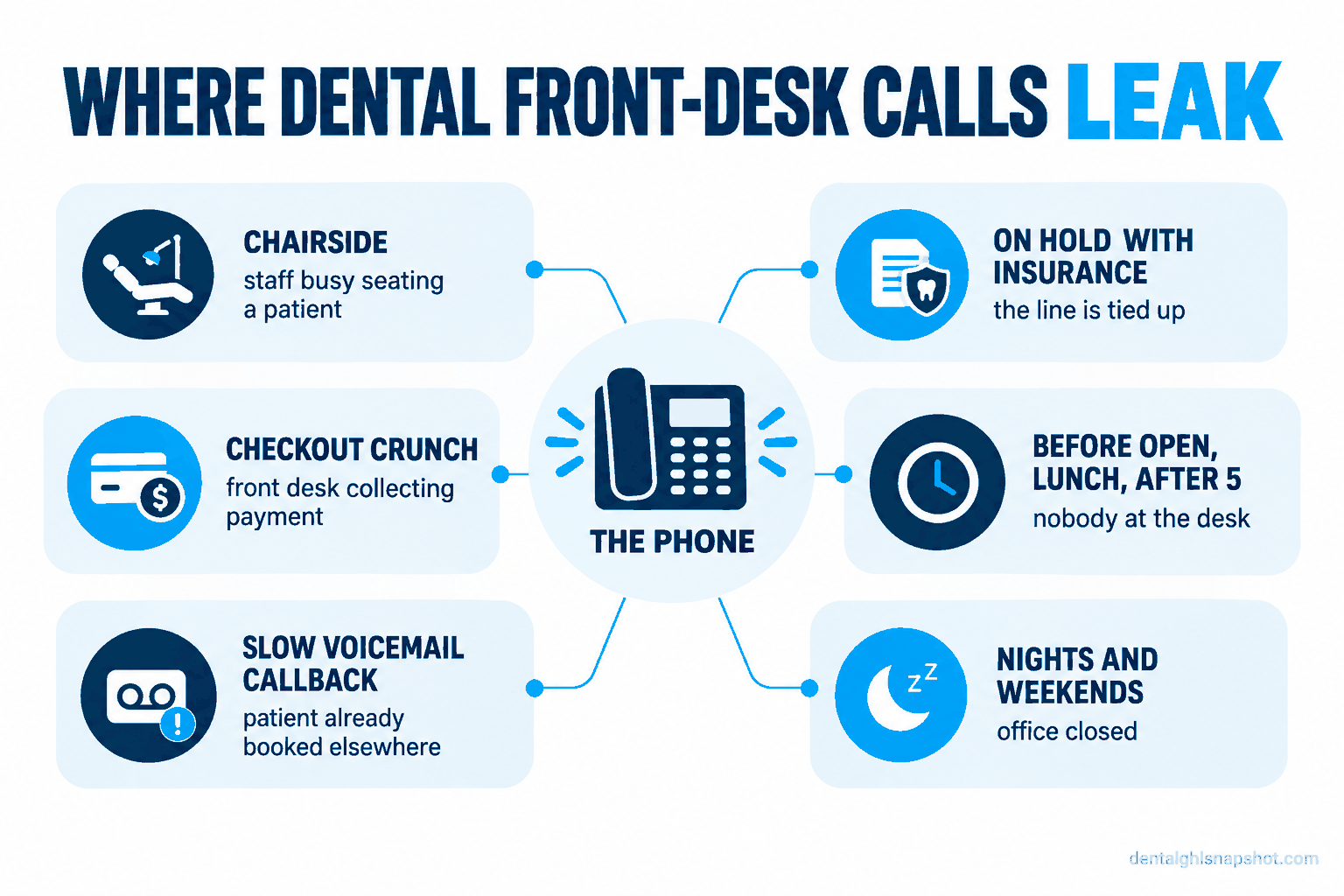
Table of contents
- What a missed call really costs you
- The six places your calls leak
- Fix it for your practice size
- Steal this: scripts and messages that catch the call
- The rules for texting a caller back
- Objections and honest answers
- FAQ
What a missed call really costs you
It is 10:15 on a Tuesday. Your one front-desk person is seating a hygiene patient and walking a nervous new arrival through a health history at the same time. The phone rings, she cannot get to it, and it rolls to voicemail. Ten minutes later it rings again, same result. By lunch the log shows four missed calls: one voicemail from a patient who wants to move Thursday, and one that is just a hang-up.
The move-Thursday call is recoverable; that patient will call back. The hang-up is the one that hurt. That was almost certainly a new patient, and new patients do not call back. They scroll to the next result and dial whoever answers. You never see the loss because it never becomes a record, just an empty slot three weeks out that you write off as a slow day.
That stings more in 2026. The average general practice grosses about $942,290 a year (ADA Survey of Dental Practice), and chairs are not as full as they were: in Q2 2026 about 26% of dentists still said they were not busy enough, down from roughly a third a year earlier (ADA HPI). One in four practices has open time a new patient could fill, and an unanswered phone is how that time stays open.
Share of U.S. dentists reporting they were “not busy enough,” by quarter. Even as it improves, one in four practices has room to fill. Source: ADA Health Policy Institute, State of the U.S. Dental Economy.
You do not need a national statistic to size your own leak. Run this number: your average production per new patient (first visit plus the treatment and recall that follow), times the new-patient calls you miss in a typical week, times fifty weeks. Do that math once and you stop treating the phone as background noise. And the phone is still the front door patients use: when researchers asked how people schedule, 56.4% named a phone call as their primary way to book a medical appointment, far ahead of online portals at 19.7% (Health Affairs Scholar, 2025). People will call. The question is whether anyone picks up.
The six places your calls leak
Stop thinking about “missed calls” as one problem. It is six situations, each with its own fix. Name them and you can close them one at a time.
1. The phone rings while the team is chairside
This is the big one. In a solo or two-op practice, the person at the desk is also greeting patients, seating them, taking payments, and answering questions in the room. When she is helping the patient in front of her, the phone waits, and callers do not. You cannot ask one person to be in two places, so calls that land during patient flow are structurally going to voicemail.
How it breaks worse: you tell the front desk to always grab the phone, so now the patient mid-check-out is ignored while the desk fields a call about office hours. You moved the leak, you did not fix it. The fix: give routine calls another way in. Missed-call text-back fires the second a call goes unanswered, so the caller gets a text in seconds instead of a beep. Online self-booking lets the “I just need an appointment” callers book without a call at all. That clears the line so the calls that need a person reach one. We break the text-back piece down in missed call text-back for dental practices, and the self-booking side in online scheduling for dental practices.
2. The front desk is stuck on hold with insurance
Verification and claims are a time sink, and they eat the phone in both directions. Your one line is tied up while your coordinator is on hold with a carrier, so every patient calling during that stretch hits a busy signal. A forty-minute hold can black out your whole late morning.
How it breaks worse: the coordinator drops the insurance call to grab an incoming patient, loses her place in the queue, and has to start over. The fix: get verification off the live phone. Batch it, route it to a portal or a service, or automate the intake so eligibility is checked before the patient arrives. We wrote the whole playbook in automating the insurance verification workflow.
3. The checkout crunch
Most appointments end in a rush: the patient at the counter settling up and booking the next visit, a hygiene patient being dismissed, and the phone picks that moment to ring. The desk is doing revenue work it cannot drop, so the call loses.
How it breaks worse: the desk rushes checkout to grab the phone, forgets to schedule the six-month recall, and you have traded a missed call for an unbooked recall, a second leak. The fix: protect checkout and catch the call another way. Text-back covers the ring, and pre-booking the next recall before the patient reaches the counter takes the scheduling task out of the crunch.
4. Before you open, at lunch, and after you close
A real chunk of calls land when the desk is not staffed at all: the 7:40 a.m. call before the doors open, the lunch hour, the after-5 call from someone who could not phone during their own workday. And the 5:45 caller is often the most motivated one you will get all day, a toothache who will dial the next office if you do not answer.
How it breaks worse: your voicemail says “our office hours are…,” which reads to a caller in pain as “we cannot help you,” and they hang up and dial on. The fix: cover the closed hours with something that answers. An AI receptionist picks up at 7:40 or 8 p.m., handles the common questions, and books into your calendar, so an after-hours call becomes a booked patient. See how in the AI receptionist for dental practices.
5. Voicemail nobody returns fast enough
Some calls do leave a voicemail, but a message sitting until 4 p.m. is often already too late, because the caller kept dialing other practices and booked while waiting for you.
How it breaks worse: the callback turns into phone tag. You call, they are busy, they call, you are chairside, and it bounces for two days. Phone tag is a slow-motion missed call. The fix: collapse the delay. Text instead of call for anything that does not need a conversation, because a text gets a reply where a callback goes unheard: a Cochrane review found automated text reminders lifted attendance to 78.6%, versus 67.8% with none (Cochrane). For new patients, responding in the first minute is what wins them, which we cover in speed-to-lead for dental practices.
6. Nights, weekends, and holidays
The phone does not know you are closed. Patients search and call Saturday afternoon and Sunday night, often the exact time a weekend toothache flares. Every one hits a dead line, and Monday you have no idea how many new patients you lost.
How it breaks worse: you assume weekend calls are rare, so you never measure the leak. The fix: put a 24/7 catcher on the line. Online booking runs all weekend, and an AI caller triages the emergency and books the routine ones, so you wake up Monday to a fuller schedule instead of a mystery.
Fix it for your practice size
The right mix depends on your size.
How to catch more calls, by practice size
| Plan | Solo (1 dentist, 2 ops) | Group (2-3 dentists, 1-3 hygienists)Recommended | Multi-location |
|---|---|---|---|
| Price | Catch the overflow | Split the load | Route and measure |
| Feature 1 | Missed-call text-back on the main line | Text-back plus an AI receptionist for peak hours | Calls and texts routed by location |
| Feature 2 | Online self-booking for routine appointments | Insurance verification moved off the live phone | 24/7 AI answering across every office |
| Feature 3 | Simple after-hours auto-reply with a booking link | Provider-aware online booking | Reporting on missed-call and text-back rates |
| Feature 4 | Pre-book recall at checkout to cut inbound calls | A named owner watches the text inbox | Consistent scripts and templates everywhere |
| Feature 5 | One shared inbox the desk checks between patients | A reply-time standard the team is held to | Overflow answering during known peak windows |
The pattern holds at every size: automate the routine calls, staff the exceptions, measure what you miss.
Steal this: scripts and messages that catch the call
You do not have to invent this copy. Drop these in and change the names.
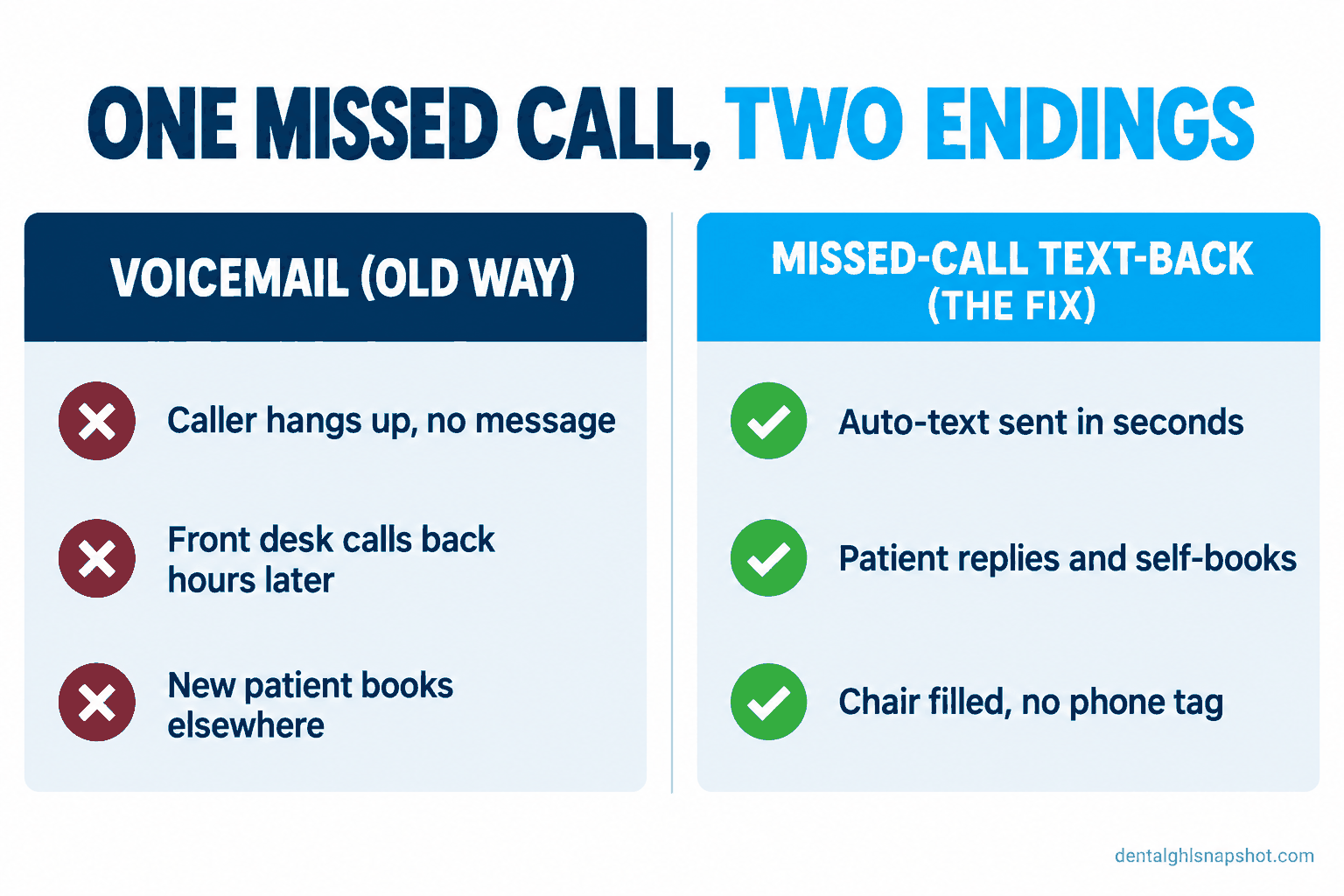
The missed-call text-back
Fires automatically the instant a call goes unanswered, so the caller gets a text before they have finished dialing the next office.
Hi, this is Riverside Dental returning your call. Sorry we missed you! I can help right here by text: are you booking a new appointment, or is this about an existing one? Reply STOP to opt out.
Why it works: it turns a dead-end voicemail into an open thread and catches the new patient before they move on.
The after-hours auto-reply
Sends when a call or message comes in outside your hours, so a 9 p.m. caller gets an immediate answer instead of silence.
Thanks for reaching Riverside Dental! We’re closed now, but you don’t have to wait for a callback. Tap [booking link] to grab an opening, or reply and we’ll confirm when we open at 8. If this is a dental emergency, call [emergency number].
Why it works: it answers the two things an after-hours caller needs, a way to book and a path for an emergency, with no one awake to say them.
The new-patient phone script (for the calls you do answer)
Train the desk to run this so the answered calls actually convert. The goal is to book, not to “give information.”
“Thanks for calling Riverside Dental, this is Marisa. Looking to get scheduled? I can get you in. Are mornings or afternoons easier? I have Thursday at 9 or Monday at 2, which works? Perfect, I’ll text your confirmation and anything to bring. What’s the best cell for you?”
Why it works: it assumes the booking, offers two specific times instead of an open-ended “when works for you,” and captures the cell number. An answered call that ends in “we’ll call you back with times” is a call you half-missed.
The rules for texting a caller back
The moment you start texting callers back, you are in regulated territory. Every tool worth using handles the mechanics, but you own the compliance. Three rulebooks apply at once.
For the full breakdown of consent language and the review rules that come with it, see can you legally text your dental patients.
Objections and honest answers
“Won’t an automated text feel impersonal to someone who wanted a person?” It feels more personal than a voicemail beep and a two-hour wait. The text-back is not pretending to be human; it says “we missed you, here’s how to get help now,” and most callers are relieved to skip the phone tag.
“We already pay for Weave, Dentrix, or Eaglesoft. Doesn’t that cover the phone?” Check what you actually have turned on. A lot of practice-management and phone tools include missed-call text-back or online booking but ship it switched off, so it never fires. The gap only exists if your tools can take a call but cannot catch the ones you miss. If you are weighing options, our Weave alternatives comparison lays out who each tool fits.
“Do I need to hire someone to watch all this?” No, that is the point. The automation handles the calls a person could not have caught anyway: the after-hours ones, the during-checkout ones, the on-hold-with-insurance ones. Self-booking and text-back siphon off the routine calls, so your existing team handles fewer, not more. You are replacing missed calls with booked appointments, not adding a job.
The bottom line
Back to that Tuesday. In a practice that has plugged the leaks, the 10:15 call got an instant text-back and the caller booked herself before lunch, the 5:45 toothache reached an AI receptionist and landed on Wednesday’s schedule, and the weekend calls fell into the online booking calendar. Monday started fuller, and nobody worked harder.
Missed calls are not a sign your team is failing. They are a sign that one person has more jobs than one person can do, and the phone is the job that quietly loses. Find your six leaks, catch the routine calls with automation and self-booking, and keep your people for the calls that need a human. The front door stays open, and the schedule shows it.
Why does my dental front desk miss so many calls?
Almost always because one person is doing several jobs at once. The front desk seats patients, checks people out, verifies insurance, and answers questions in the room, and the phone rings during those exact busy minutes. It is a staffing math problem, not a discipline problem. The fix is to route routine calls to automation and self-booking so your team can focus on the calls that truly need a person.
How much does a missed call actually cost a dental practice?
The expensive misses are new-patient calls, because new patients rarely call back; they dial the next practice that answers. To size your own loss, multiply your average production per new patient (first visit plus the treatment and recall that follow) by the new-patient calls you miss in a typical week, then by about 50 weeks. Most office managers are surprised how large that annual number is.
What is missed-call text-back and does it work for dentists?
It automatically texts any caller you could not answer, usually within seconds. Instead of a voicemail beep, the caller gets a message inviting them to book or reply by text. It works well for dental practices because it catches the calls a busy front desk structurally cannot answer, and because many people would rather text than leave a voicemail and wait.
Should we use an AI receptionist to answer after-hours calls?
It is a strong fit for the hours a person is not there: before you open, at lunch, after close, and on weekends. It can answer common questions, triage a possible emergency, and book routine appointments into your calendar around the clock, so an after-hours call becomes a booked patient instead of a dead line. During business hours it works alongside your team, catching overflow at peak times.
Is it legal to text a patient back after a missed call?
Yes, if you follow the rules. Under the TCPA you need the patient's consent to text and must honor a STOP opt-out immediately. Under HIPAA a text may include a name, date, time, provider, and booking link, but nothing clinical like a procedure or balance, because it shows on a lock screen. You also need a signed Business Associate Agreement with any vendor that texts on your behalf, and some states have stricter texting laws.
Will fixing missed calls mean hiring more front-desk staff?
Usually not. The goal is to reduce the calls a person has to handle, not add a hire. Self-booking lets routine appointments happen without a call, text-back catches the ones your team could not reach, and an AI receptionist covers unstaffed hours. Your existing team ends up fielding fewer, higher-value calls.