

Short answer: In New York City — 8.48 million people (U.S. Census Bureau, 2024) choosing among a state with roughly 14,929 licensed dentists as of 2020 (NYS Department of Labor) — a growing share of new patients don’t call. They send a DM. More than 1 billion people message a business every week across Instagram, Messenger, and WhatsApp, and 150 million have a conversation with a business on Instagram every month (Meta, via Adweek). The problem: those messages arrive nights, weekends, and mid-column when the front desk can’t touch them — and 23% of businesses never respond to an inbound inquiry at all, taking an average of 42 hours when they do (Harvard Business Review). DM automation closes that gap: an AI agent answers the Instagram and Facebook message in seconds, qualifies the patient, and books the appointment straight into your calendar — 24/7. This is the data behind why NYC practices need it, and exactly how it works.
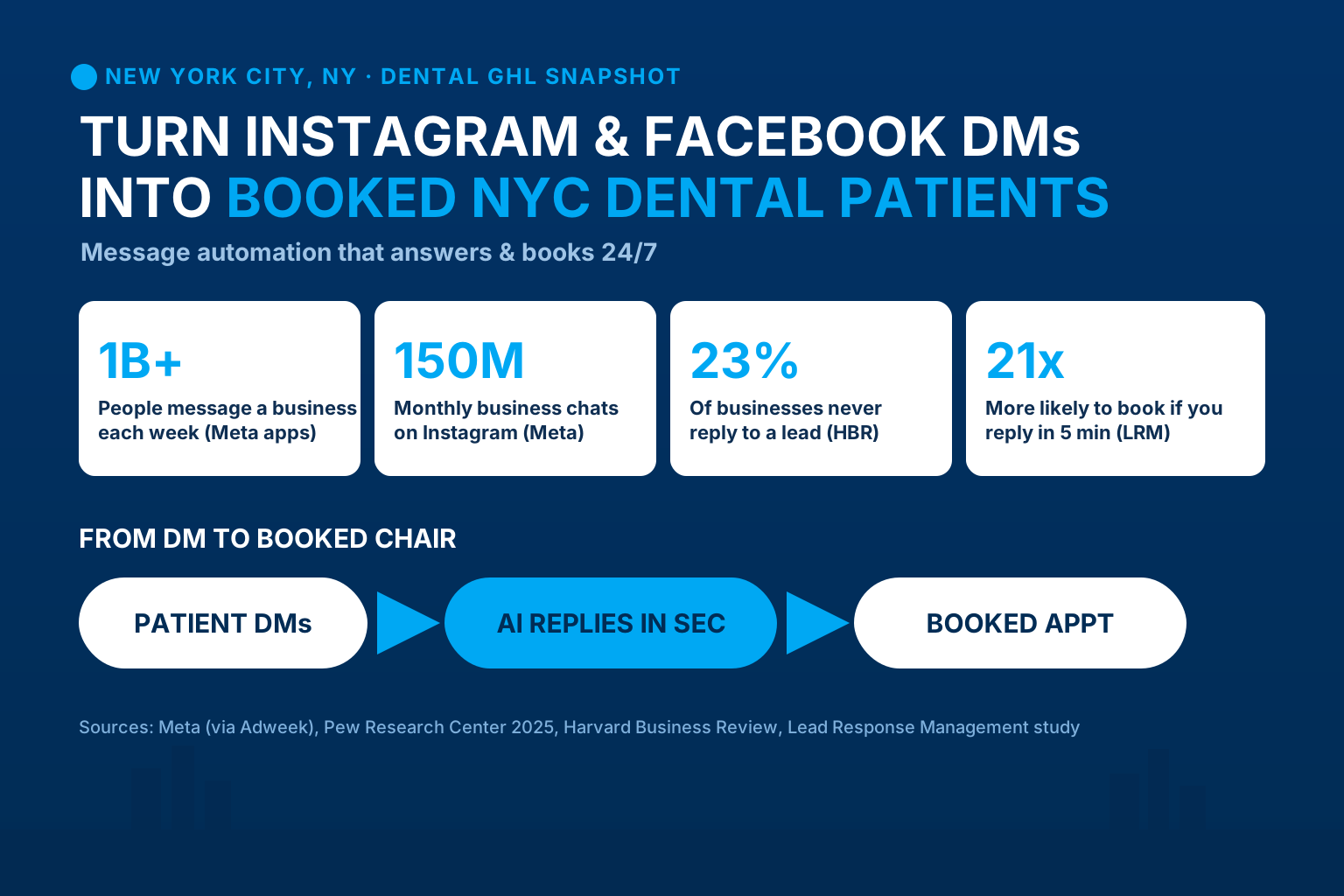
Table of contents
- Why NYC dental patients now book through the DMs
- The hidden cost of a slow reply
- What DM automation actually does
- From DM to booked chair: the four-step flow
- In-house vs. done-for-you: the honest math
- How to tell if it’s working
- FAQ
Why NYC dental patients now book through the DMs
New York City is the densest, most competitive dental market in the country. Roughly 8.48 million people live across the five boroughs (U.S. Census Bureau, 2024), and New York State counted 14,929 licensed dentists as of 2020 (NYS Department of Labor) — one of the top three states for active dentists in the nation (Statista, 2024). When a prospective patient in Astoria or Park Slope searches “cosmetic dentist near me,” they get a wall of options. The practice that answers first usually wins — and increasingly, “answering” means replying to a message, not a phone call.
That’s because messaging has quietly become a primary way people contact businesses. More than a billion people message a business each week across Instagram, Messenger, and WhatsApp, and 150 million have a conversation with a business on Instagram every month (Meta, via Adweek). Your future patients are already on these apps in enormous numbers: Pew Research Center’s 2025 survey of U.S. adults found 71% use Facebook and 50% use Instagram, and among adults under 30 — the exact cosmetic, ortho, and Invisalign buyers a NYC practice wants — 80% use Instagram (Pew Research Center, 2025).
Share of U.S. adults who use each platform. Facebook and Instagram — where DMs happen — reach the majority of your patients. Source: Pew Research Center, 2025.
So the modern NYC patient journey looks like this: they see a Reel or a Google listing, they tap through to your Instagram or Facebook page, and — instead of calling during their workday — they fire off a DM or drop a comment: “Do you take Delta Dental?” “How much for Invisalign?” “Any Saturday appointments?” If that message is answered in seconds, you’ve got a booking. If it sits until tomorrow, they’ve already messaged three other practices. This is the same discovery-to-decision path we cover in social media marketing for dental practices — DM automation is the layer that catches the demand your content creates.
The hidden cost of a slow reply
The economics of response time are brutal and well-documented. In a landmark audit of 2,241 U.S. companies, Harvard Business Review found that firms contacting an inbound lead within an hour were 7× more likely to qualify it than firms that waited just one hour longer — and more than 60× more likely than those that waited 24 hours or more. Worse, 23% of the companies never responded at all, and the average first response took 42 hours (Harvard Business Review).
Zoom in tighter and the curve gets steeper. The widely cited Lead Response Management study (Dr. James Oldroyd) found that replying to a web lead within 5 minutes rather than 30 makes you 21× more likely to qualify that lead (Lead Response Management study). The first five minutes are decisive — and no chairside NYC front desk can hit them by hand.
Relative likelihood of qualifying a lead by reply speed (indexed to a 30-minute reply = 1). Source: Lead Response Management study.
Patients feel this too, and they don’t forgive it. Sprout Social’s 2025 research found that 73% of consumers expect a brand to respond on social media within 24 hours, and 73% will buy from a competitor after a poor experience with a brand on social (Sprout Social, 2025). In a market with a dentist on nearly every block, a message that goes cold overnight isn’t a small miss — it’s a new patient handed to the practice down the street.
What DM automation actually does
DM automation puts an AI agent on your social inboxes so no message ever waits for a spare minute. It’s not a clunky keyword auto-responder — it reads the patient’s actual question, answers in your practice’s voice, and drives toward a booking. In our done-for-you dental social system, three agents cover the whole surface:
- AI Comment Agent — automatically replies to comments on your Instagram, Facebook, and TikTok posts. When someone comments “how much are veneers?” under a Reel, it answers publicly and nudges them to DM, so no thread goes cold and the algorithm keeps boosting your reach.
- AI DM Agent — answers Facebook and Instagram direct messages 24/7. It handles the real questions (insurance, treatments, availability), collects the patient’s name and contact details, and books the appointment straight onto your calendar.
- AI Web Chat Agent — the same capability on your website, so visitors who click through from social also get answered and booked. (More on that in dental website chatbots.)
Crucially, the agent doesn’t just reply — it qualifies and books. It captures name, phone, and reason for visit, checks your real availability, and writes the appointment into the CRM your front desk already watches. Every lead and every booking is visible with your own login, and appointments can sync to the Google Calendar your team runs on — no double-entry, nothing hidden.
A few guardrails matter for a dental practice specifically. The agent is built to educate and book, not to promise clinical outcomes — which keeps you clear of state dental-board advertising rules. And because DMs are not a secure channel, it collects contact details and reason for visit only; protected health information stays out of social messages and plain SMS, consistent with HIPAA best practice.
From DM to booked chair: the four-step flow
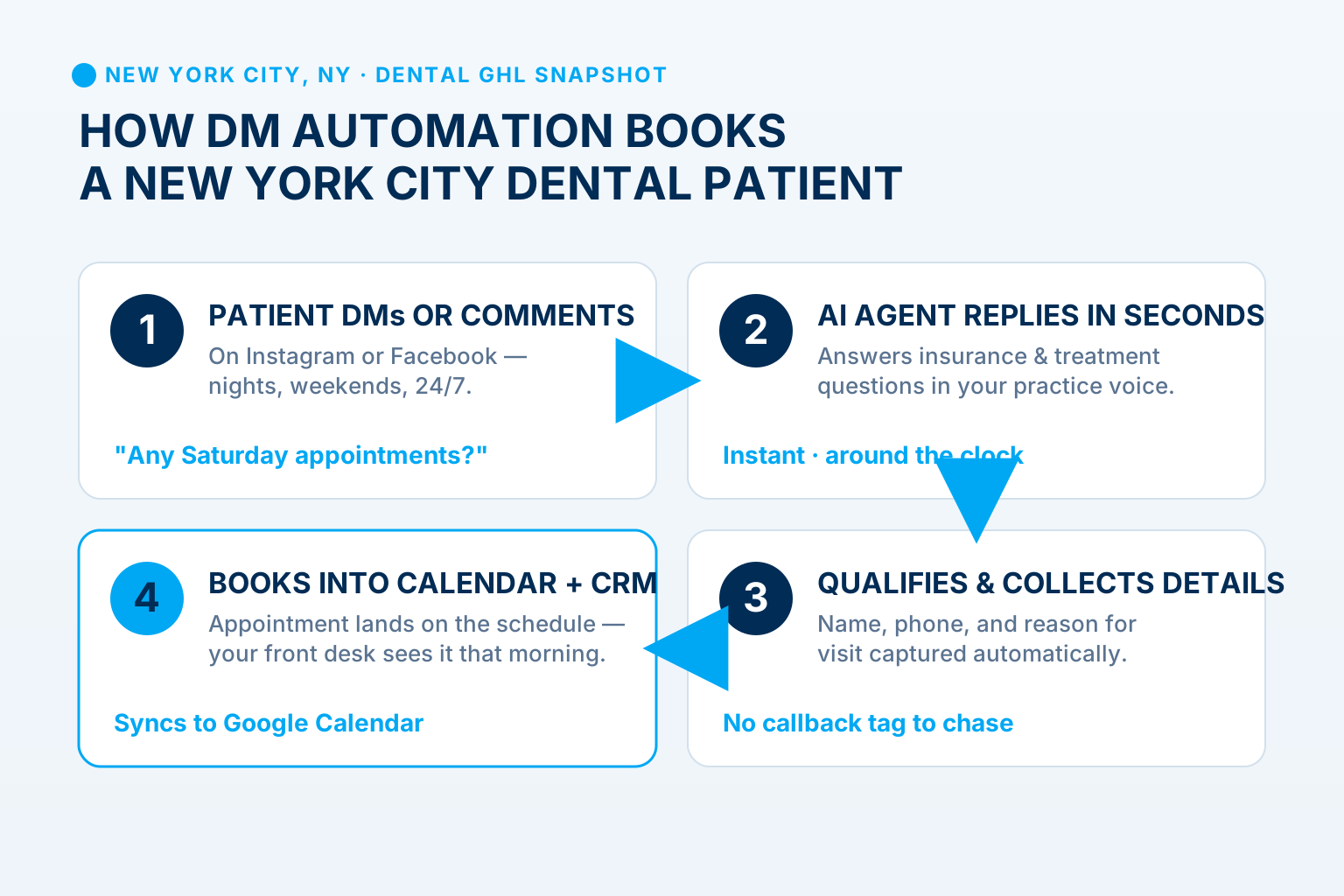
Here’s the exact path a New York City new-patient inquiry travels once automation is in place. Steps two and three are where a manual front desk leaks patients — and where the AI never blinks.
- A patient messages or comments. “Do you have anything after work this week?” lands in your Instagram or Facebook inbox at 9:40 p.m. — or as a comment under your latest Reel.
- The AI agent replies in seconds. It answers the real question — insurance accepted, treatment basics, next available times — in your practice’s voice, day or night.
- It qualifies and collects details. Name, phone number, and reason for visit are captured and logged. No form to chase, no callback tag left on a sticky note.
- It books the appointment. The AI checks live availability and writes the appointment into your calendar and CRM, where your front desk sees it the next morning already on the schedule.
That’s the speed-to-lead principle applied to social messaging: answer in seconds, every time, and let the booking land itself. The difference between this and a posting-only social strategy is the difference between reach and revenue.
What changes when the DMs run on automation
Instagram and Facebook messages pile up until someone at the front desk has a free minute. Half get answered the next business day; some never do. Comments under Reels go cold. New-patient inquiries from social are impossible to track, and the ones you lose, you never see.
Every DM and comment answered in seconds, 24/7, in your practice voice. Patients qualified and booked straight into the calendar. Every lead and appointment logged in the CRM. After-hours inquiries become morning appointments instead of missed chances.
In-house vs. done-for-you: the honest math
There are three realistic ways a NYC practice can cover its social inboxes. Here’s the trade-off.
| Plan | Front desk answers manually | Hire a dedicated social/community manager | Done-for-you DM automation |
|---|---|---|---|
| Price | 'Free' — until you count missed messages | Salary + benefits (a full FTE) | From $397/mo |
| Feature 1 | No new tool to buy | Dedicated human attention during their shift | AI answers comments, DMs & web chat 24/7 in your voice |
| Feature 2 | Only covers business hours — nights and weekends go dark | Still can't cover 24/7 without multiple hires | Qualifies patients and books into your calendar automatically |
| Feature 3 | Chairside team can't hit the 5-minute window that wins bookings | Single point of failure — vacations, turnover, sick days | Every lead and appointment visible in the CRM you own |
| Feature 4 | Comments under posts go unanswered, hurting reach | Needs tooling for scheduling and CRM sync anyway | Built for dental, compliant, white-label |
| Feature 5 | New-patient inquiries from social are rarely tracked | Ramp-up time before it runs smoothly | Includes the content engine that creates the inbound demand |
The reason the third column exists is that speed and coverage are the two things a chairside practice cannot sustain by hand. A single human, however good, sleeps, takes lunch, and goes on vacation — and the 9 p.m. Instagram DM from a prospective implant patient doesn’t wait. Automation compresses the whole thing into one predictable line item and guarantees the one metric that drives bookings: an instant, qualified reply, every time.
How to tell if it’s working
Vanity metrics (raw follower count) won’t tell you if your inboxes are converting. Track the numbers that connect to production:
- Response time. Median time to first reply on Instagram and Facebook DMs. With automation this should be seconds, around the clock — the metric HBR and the Lead Response Management study prove matters most.
- Inquiries captured. DMs and comments that turned into a qualified lead with name, contact, and reason for visit.
- Booked appointments from social. The only metric that pays the bills — appointments that trace back to a DM, comment, or web chat, tagged in your CRM.
- After-hours share. What percentage of captured inquiries arrived outside business hours? That’s the volume your old process was silently losing.
- Reviews earned. Fast, helpful replies feed reputation. 97% of consumers read online reviews for local businesses (BrightLocal, 2024), so pair DM automation with a review-harvesting system to close the loop.
A monthly read on those five numbers tells you exactly what your social inboxes are worth — and how many patients your practice used to leave on the table. If you want to sanity-check the upstream economics for your own practice, the pricing page and a quick walkthrough call are the fastest way to model it.
Frequently asked questions
Frequently asked questions
Do dental patients really book appointments through Instagram and Facebook DMs?
Increasingly, yes. More than 1 billion people message a business each week across Meta's apps, and 150 million have a conversation with a business on Instagram every month (Meta, via Adweek). With 71% of U.S. adults on Facebook and 80% of under-30s on Instagram (Pew, 2025), a growing share of new-patient inquiries in a market like NYC now start as a DM or a comment rather than a phone call.
How fast does an AI DM agent respond, and why does speed matter so much?
In seconds, 24/7. Speed is decisive: firms that respond within an hour are 7× more likely to qualify a lead than those who wait an hour longer, and 60× more than those who wait a day (HBR). Replying in 5 minutes versus 30 makes you 21× more likely to qualify (Lead Response Management study). A chairside NYC front desk simply can't hit that window by hand — automation can.
Will the AI book straight into the calendar my front desk already uses?
Yes. The agent captures the patient's name, phone, and reason for visit, checks your real availability, and writes the appointment into the CRM — and appointments can sync to your Google Calendar so your team sees them in the tool they already run on. Every lead and booking is visible with your own login; nothing is hidden from the front desk.
Is DM automation compliant with dental advertising and privacy rules?
It can be, and it must be. The agent is built to educate and book — never to promise clinical outcomes — which keeps you clear of state dental-board advertising rules. Because social DMs aren't a secure channel, it collects only contact details and reason for visit; keep protected health information out of DMs and plain SMS, consistent with HIPAA best practice. Messaging honors opt-outs (reply STOP).
Does this replace my front desk?
No — it protects them. The AI handles the repetitive, after-hours, and simultaneous messages that a chairside team can't reach, then hands a booked, qualified appointment to your staff. Your team spends its time on patients in the chair instead of chasing cold inboxes, and no inquiry falls through the cracks.
How much does done-for-you DM automation cost for a NYC practice?
Our done-for-you dental social service — which includes the three AI agents for comments, DMs, and web chat plus the content engine that creates the inbound demand — is $397/mo for one brand and $997/mo for up to four locations, white-label. See the social media service for what's included, or book a 20-minute walkthrough.
About the author
Devin Okafor is a GoHighLevel Automation Specialist based in Austin, Texas. He builds and ships GoHighLevel snapshots for dental practices and the agencies that serve them, and has wired up hundreds of workflows for appointment reminders, speed-to-lead, review harvesting, and DM automation. He is opinionated about keeping automations simple enough for a busy front desk to maintain.
Related posts
- Missed-Call Text-Back for Dental Practices: Recover the Patients You Never Knew You Lost
- Speed-to-Lead for Dental Practices: Why the First 5 Minutes Decide the Booking
- Dental Website Chatbot: Turn Website Visitors Into Booked Appointments
- Social Media Marketing for Miami Dental Practices: Why Short-Form Video Wins New Patients
- How Dental Practices Earn More 5-Star Reviews Without Begging For Them