

Short answer: Most dental plans run on a calendar-year benefit period. The annual maximum, around $1,000 to $2,000, resets to zero on January 1 and the unused part does not roll over. So every December two things happen at once: patients who accepted treatment but never scheduled it are about to forfeit money that would have paid for it, and your December column has holes in it. The practices that turn that into a full schedule do not send one “use your benefits” email on December 15. They run a quiet, staged sequence from late September through January that finds the right patients, reaches them on the channel they answer, and books them before the window closes. Below is that sequence, stage by stage, with the messages to send and the compliance line you cannot cross.
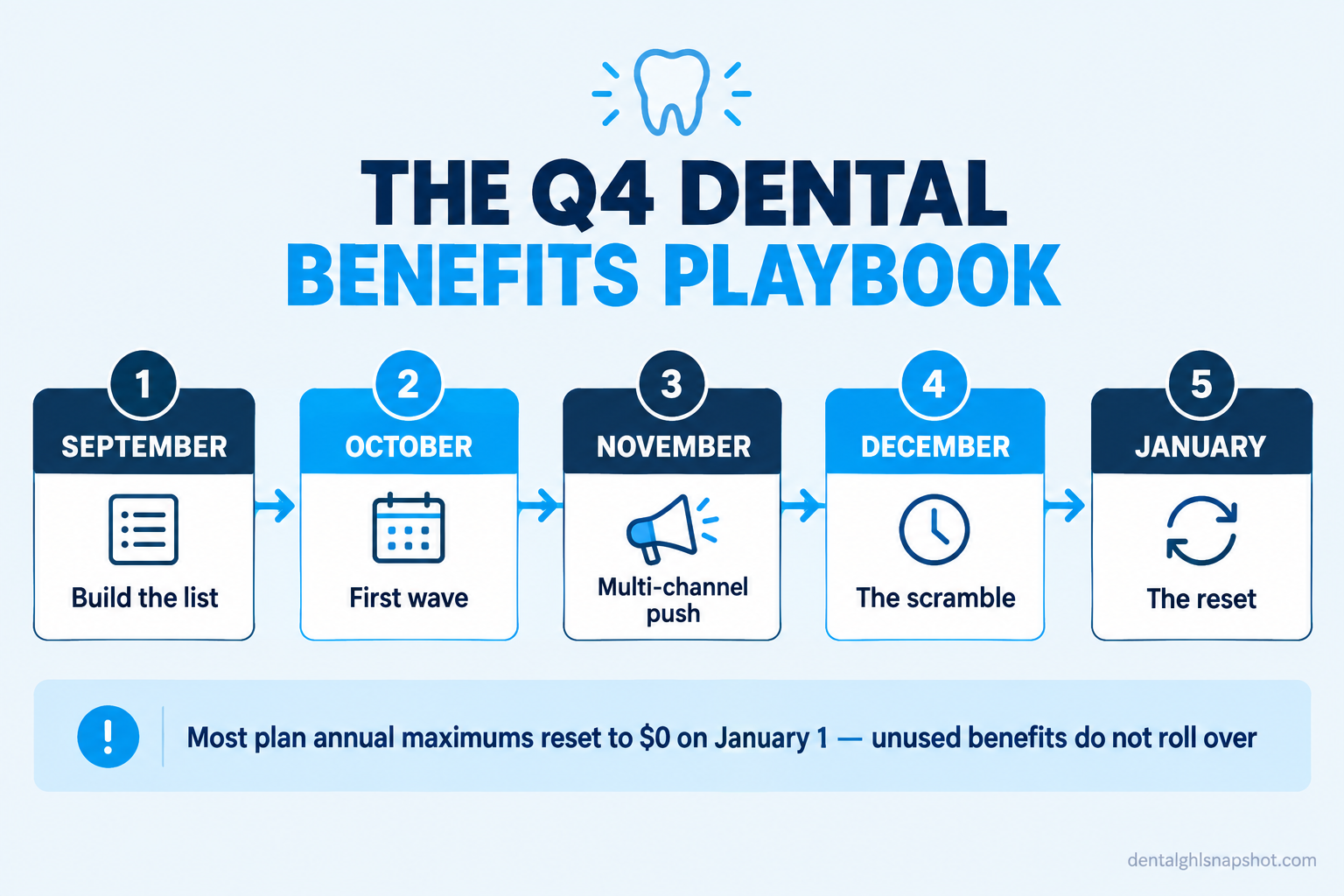
Table of contents
- Why year-end benefits fill your schedule
- What actually resets on January 1
- The five-stage Q4 playbook
- Run it for your size
- The compliance line
- Objections and honest answers
- FAQ
Why year-end benefits fill your schedule
It is the last week of September. You are looking at the December schedule and it has gaps, the kind that always seem to fill “later” and then do not. Sitting in a report you have not run since spring are two or three hundred patients who accepted a crown, a night guard, or fillings months ago and never scheduled. Their insurance would pay a chunk of it. On December 31, the part of their annual maximum they never touched vanishes.
That is the opportunity in one sentence: money the patient already has, for treatment they already agreed to, on a deadline that is real. You are not inventing urgency; you are reminding people of a deadline their own insurer set.
It matters more this year because chairs are harder to fill. As of the fourth quarter of 2025, roughly a third of dentists (about 33%) told the ADA Health Policy Institute they were not busy enough to fill the schedule, up from about a quarter a year earlier (ADA HPI).
Share of U.S. dentists reporting they were “not busy enough” to fill the schedule, percent, fourth quarter. Source: ADA Health Policy Institute, State of the U.S. Dental Economy.
When chairs are harder to fill, the patients already in your database are the cheapest production you can find. With the average general practice billing $942,290 a year (ADA 2024 Survey of Dental Practice), a full December is money that either lands this year or walks out the door. Patients ignore the deadline only because nobody makes it easy: they do not know their remaining maximum, and a vague “you have unused benefits” sounds like a sales line.
What actually resets on January 1
Get the mechanics right first, because a patient will call and ask.
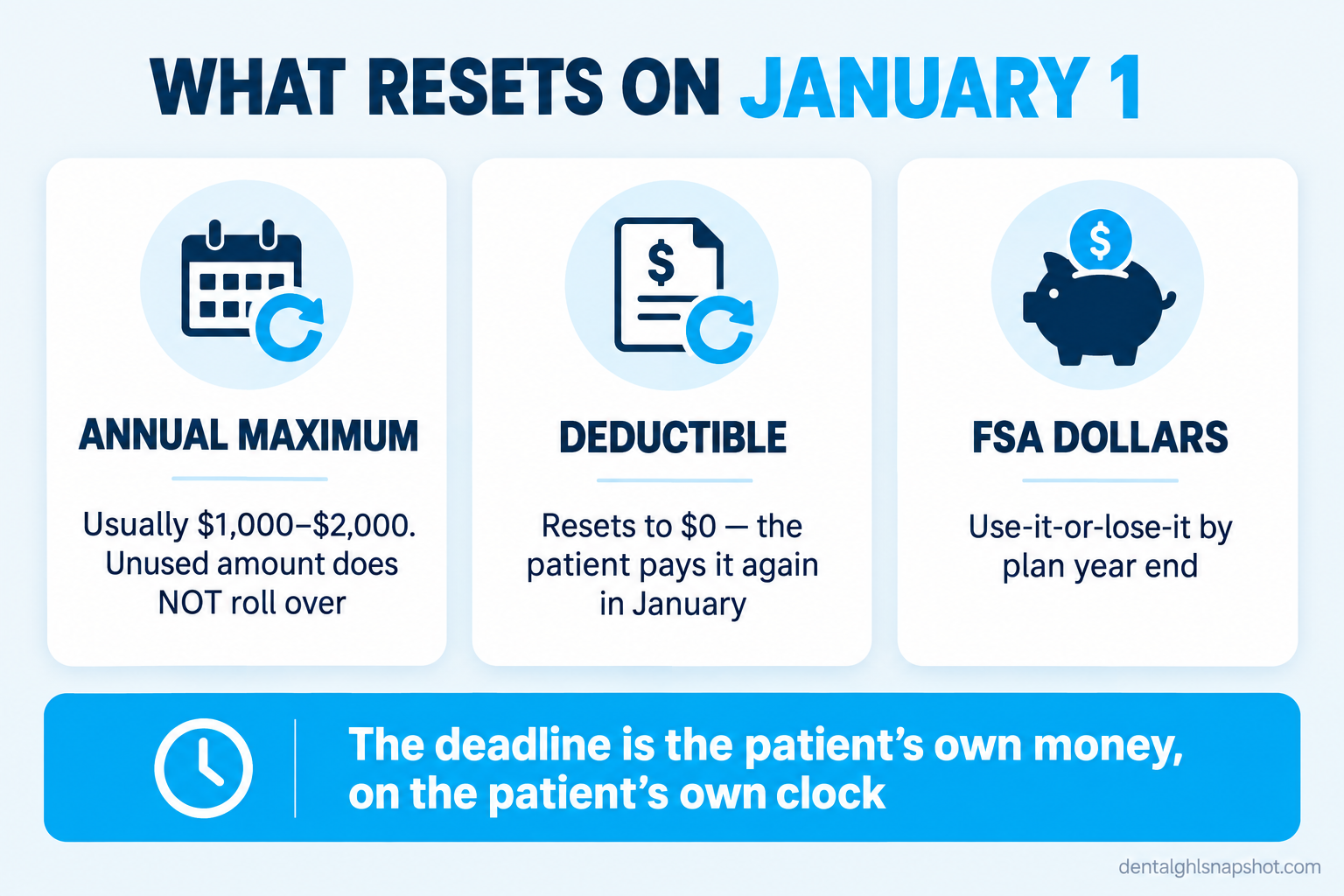
The annual maximum. The ceiling the plan will pay in a benefit year, commonly $1,000 to $2,000. Most plans run on a calendar year, and whatever the patient did not use does not carry over (NADP). A patient with a $1,500 maximum who used $300 on cleanings loses $1,200 of coverage at midnight on December 31.
The deductible. The patient pays this before the plan starts paying, and it also resets January 1. Someone who already met it gets more value finishing now than starting fresh in January and paying it again.
FSA money. Many patients fund a Flexible Spending Account through work, and most are “use it or lose it” by the plan year’s end (IRS Publication 969). Dental work is eligible, so a patient with a few hundred FSA dollars has a second deadline pushing the same way.
The message writes itself: finish what you started while your insurance still covers it.
The five-stage Q4 playbook
The mistake almost every practice makes is treating year-end as a single December event, when the schedule is already tight and the good times are gone. The practices that win the quarter spread the work across four months and let automation carry the repetition.
Stage 1 (late September): build the list
You cannot automate a message to a list that does not exist. Pull three lists out of your practice management system, because they need different messages.
- Unscheduled accepted treatment. Patients who said yes to a plan and never booked. Highest value, usually shortest. Run the treatment-plan report in Dentrix, Eaglesoft, or Open Dental. For the ones stuck at “I’ll think about it,” the case-acceptance follow-up playbook is the companion to this one.
- Overdue and soon-due hygiene. Patients past their recare date, plus anyone due before December 31. The biggest and easiest list to book.
- Known unused benefits. If your verification process tracks remaining benefits, these patients get the most specific message of all.
The failure mode: skipping the list-building and blasting the whole database, which annoys the patients who were just in and hides the twenty people with a $1,200 crown inside a message meant for everyone. To make it repeat every recare cycle, wire the overdue-hygiene pull into an always-on system like the one in our recall and reactivation playbook.
Stage 2 (mid-October): the first wave
October is for warming people up, not the hard deadline. Countdown language does not land yet, and starting it now just exhausts it by December. Email carries this one well because it has room to explain.
The failure mode is sending the October wave with December’s panic. Keep it warm. You are opening a door, not slamming one.
Stage 3 (November): the multi-channel push
November is where most year-end bookings happen: the deadline feels real, but there is still room on the calendar. Run a sequence across channels, not one message repeated.
- Email first, now naming the December 31 deadline for calendar-year plans and leading with the booking link.
- SMS a few days later, only to patients who did not book from the email. Texting people who already scheduled makes you look like you are not paying attention.
- A real phone call for the high-value list. The patient with four-figure accepted treatment does not get a text and nothing else. The automation’s job is to hand the front desk a tight call list and a script, not to replace the call.
Keep the SMS under two lines and never put the procedure or dollar amount in it:
The failure mode in November is channel collision: the same patient getting the email, the text, and the call on one day because the tools do not talk to each other. If a patient books, every remaining message has to stop. That is the single most important automation rule in this play, and the one most manual setups get wrong.
Stage 4 (last two weeks of December): the scramble
Now the deadline is genuine and you can say so plainly. Two things run at once. First, a final-push message to anyone still unbooked. Second, and this is what separates a good December from a great one, a short-notice cancellation list. December has more cancellations than any month, and every opening that goes unfilled is benefits money that expires that night. So the moment a slot opens, an automated text goes to a pre-built list of patients who wanted the soonest time.
The failure mode is treating December cancellations as losses instead of openings. If backfilling depends on someone at the desk noticing the hole between patients, it will not happen in the busiest two weeks of the year. This is the fill-the-cancellation ASAP-list mechanic pointed at the year-end window, and it has to be automatic.
Stage 5 (January): the reset
Most practices exhale on January 1 and lose the easiest bookings of the quarter. Three things just moved in your patients’ favor:
- Deductibles reset, so patients starting new treatment often want to knock the deductible out early.
- FSA and HSA balances reloaded, so the money conversation is easy again.
- Everyone who missed December is still in your unscheduled list, and now the message is “let’s get you started while your benefits are fresh.”
A single warm January email to the ones who did not book in Q4 recovers a meaningful slice of them, and you already did the hard work of identifying them.
Run it for your size
The five stages are the same for everyone. What changes with your size is how much you automate versus do by hand.
The Q4 play by practice size
| Plan | Solo GP (1 dentist) | Mid (2–3 ops)Recommended | Group / multi-site |
|---|---|---|---|
| Price | Automate all but the call | Segment, then automate | Same play, per location |
| Feature 1 | One combined list is fine; you know these patients | Three separate lists, because volume hides high-value cases | Each location gets its own lists and booking links |
| Feature 2 | October email and November SMS run automatically | Full email to SMS to call sequence with book-and-stop logic | One person or system runs the sequence across sites |
| Feature 3 | You personally call the top 10–15 accepted-treatment cases | Cancellation backfill matters most; you have the most slots | Watch state messaging rules if locations span states |
The compliance line
This is the part that gets skipped, and the part that bites. The year-end play sends a lot of messages about patient information, so it sits on top of three sets of rules.
HIPAA: what a message may say. A practice can text and email patients about appointments; what it cannot do is expose protected health information on a lock screen. So the message carries the date, time, provider, and a booking link, and nothing else. It never names the procedure, states a balance, or mentions a diagnosis. Appointment reminders count as a treatment communication and are allowed, but reasonable safeguards still apply (HHS). That is why the SMS above says “your benefits,” never “your $1,200 crown.” Any vendor that stores or sends this data must sign a BAA first.
TCPA and consent. Automated marketing texts generally need the patient’s prior express consent, and every message needs a working opt-out. Honor STOP immediately and keep the record (FCC on unwanted texts). The federal rules have been in flux lately, so treat this as posture, not legal advice: the “come use your benefits” nudge is close enough to marketing that you treat it like marketing, and carrier A2P 10DLC rules require consent regardless. Several states, including Washington, Oklahoma, Maryland, and Florida, have stricter laws that apply based on where the patient is, so texting across state lines means the strictest rule wins.
FTC: do not gate your reviews. The natural next step after a full December is asking happy patients for a Google review. What you cannot do is filter the ask by satisfaction, sending it only to patients you expect to rate you well, or routing unhappy ones somewhere private to keep them off public sites. Soliciting reviews in a way that suppresses or filters negative feedback can run afoul of the FTC’s rule on fake and manipulated reviews, effective October 2024 (FTC). Ask everyone the same way.
Objections and honest answers
“Won’t patients feel pressured or think we’re just after money?” They feel pressured when the message is vague and pushy, and helped when it is specific and true. “Your benefits reset January 1 and unused amounts do not carry over” is a fact about their money, not a sales tactic. Lead with the benefit to them, keep the tone warm, make the next step one tap. The low-pressure October wave earns you the right to be direct in December.
“We already send appointment reminders. Isn’t that enough?” Reminders go to people who already have an appointment. This play goes to the people who do not, which is where the empty December slots come from. A reminder keeps a booked patient from no-showing; the year-end sequence gets an unbooked patient to book. You need both.
“It’s late September and we’re already slammed. Is it too late?” No. Late September is the ideal week to start: Stage 1 is just running three reports, and the rest is messages you schedule once and let run. Start now rather than November because the good December times are still open, and every week you wait the calendar tightens. If setting it up by hand is the blocker, that is what a done-for-you automation system is for.
“A lot of our patients are cash or uninsured. Does this still work?” Yes, with a tweak. For cash patients the deadline is the calendar and often their FSA or HSA. The list-building and sequence are identical; you just swap the “benefits reset” line for “use your FSA before it expires.”
Frequently asked questions
When do dental insurance benefits actually reset?
Most plans use a calendar-year benefit period that resets January 1, so the unused annual maximum expires December 31 and does not roll over, and the deductible starts fresh. Some employer plans reset on a different date, so confirm the plan during verification before promising a deadline.
How much of a plan's annual maximum goes unused?
It varies by patient and plan; maximums commonly run $1,000 to $2,000, and a patient who only had preventive visits often leaves most of it untouched. The year-end play reaches patients with accepted-but-unscheduled treatment so coverage pays for care instead of expiring.
When should a small practice start its year-end campaign?
Late September. Stage one is just pulling three reports (unscheduled accepted treatment, overdue hygiene, and known unused benefits), and warming patients up in October then pushing across email, SMS, and phone in November beats a single December blast because the best December times are still open earlier.
Can we text patients that their benefits are expiring?
Yes, done correctly. The text can name the calendar-year reset and link to booking, but never a procedure name, balance, or diagnosis, because that exposes protected health information on a lock screen. You also need consent, a working STOP opt-out, and a signed BAA with any vendor handling the data.
Is it legal to only ask happy patients for a review?
It is risky and best avoided. Soliciting reviews only from patients you expect to rate you well, or routing dissatisfied ones away from public sites, can run afoul of the FTC's 2024 rule on fake and manipulated reviews and the platforms' own policies. Ask every patient the same way.
Does January really matter, or is the window over on January 1?
January is one of the best booking months of the quarter: deductibles reset, FSA and HSA balances reload, and everyone who missed December is still in your unscheduled list. A warm January email to those patients recovers a meaningful share the year-end push did not catch.
The bottom line
Back to that last week of September and the December schedule with holes in it. The difference between the practice that ends the year full and the one that watches benefits expire is not a bigger budget or a louder December. It is starting now, building three clean lists, and running a calm four-month sequence built around a deadline that is theirs. The tools do the repetitive part; you spend your time on the calls worth a person’s voice. On January 1, instead of forfeited benefits, you have a full December behind you and the easiest bookings of the year ahead.